 Skip to content
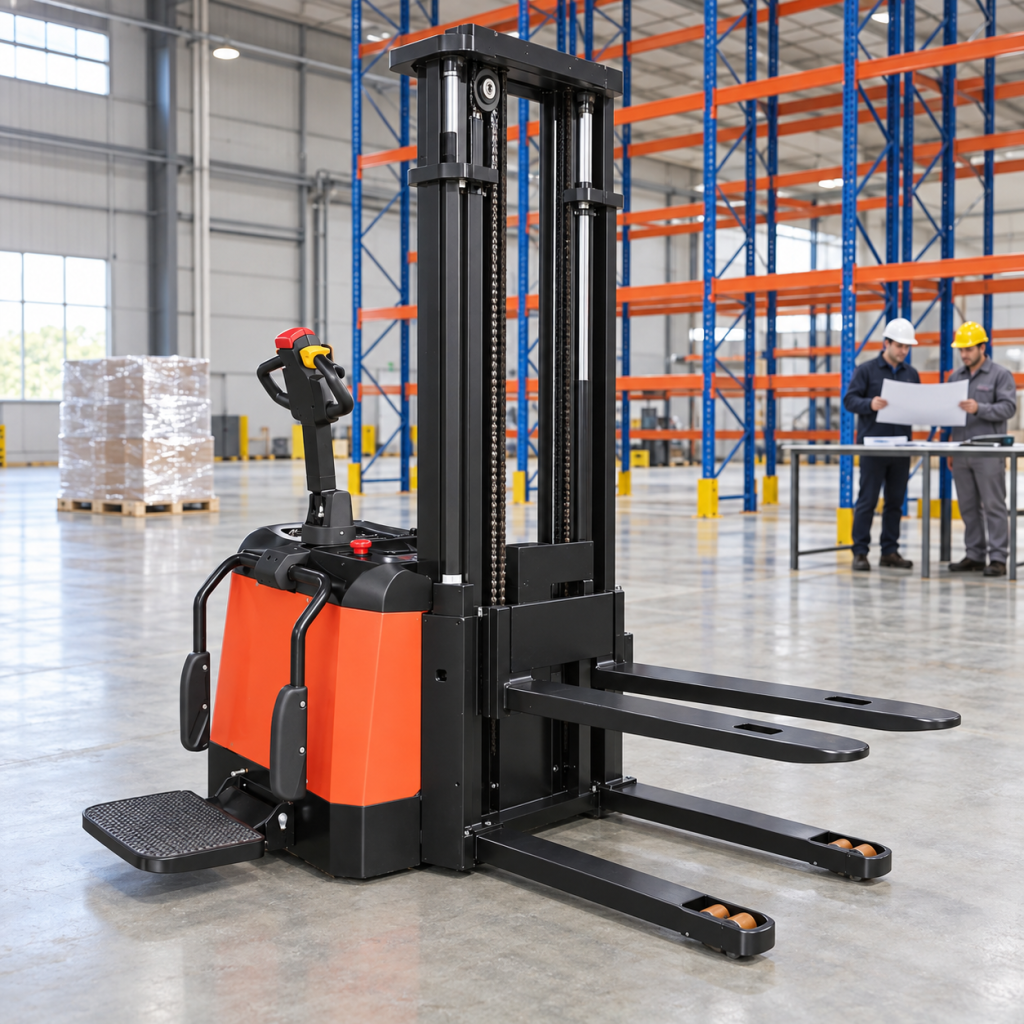
A stacker may carry a pallet at floor level but lack the approved capacity to place that pallet on the highest rack. A headline rating alone leaves this question unanswered.
Evaluate capacity for the exact truck, lift height, load centre and configuration. Record the real pallet and load, identify the highest regular placement, then obtain the proposed stacker's manufacturer capacity information. Do not estimate a safe high-lift load from a lower-height rating or a different model's chart.

Illustrative scene generated from a Jinge product photograph; it is not a capacity test or customer-site photograph.
What does a stacker capacity rating actually describe?
A pallet can weigh less than the headline rating while its high-rack lift remains outside the approved conditions. The rating has limits.
A rated load is tied to conditions, including load centre and lift height, rather than every pallet the truck might encounter. Read the exact truck's capacity plate or manufacturer chart and check what is included in the load, which mast and forks are fitted, and the height being considered.
Sales material often highlights a single capacity value because it is easy to compare. For rack placement, the buyer needs more context. A pallet containing a dense block of goods close to the mast does not behave like a long load whose weight is farther along the forks. The same weight can present different stability demands when the load centre moves. A different mast, attachment or fork arrangement may also require different approved capacity information.
A Crown walkie-stacker operator manual defines capacity as the load, including pallet or container, that can be lifted to a given height at a given load centre. Its sample capacity plate illustrates the information an operator needs, while warning that the sample values do not apply to another truck. That manual is a technical example for Crown equipment, not a GODWIN or Jinge rating. The same evidence principle applies to a purchase: request the current plate or chart for the exact proposed build.
| Rating element | What the buyer should ask for | Why it matters |
|---|---|---|
| Truck identity | Exact model and configuration revision | A similar-looking truck may have another rating |
| Load centre | Stated reference distance and measurement method | Long or offset loads may exceed that condition |
| Lift height | Capacity at the required placement height | Ground handling does not prove high-rack suitability |
| Included equipment | Mast, forks, platform and any attachment | Options can change the approved configuration |
Do not turn a catalogue headline into a guarantee for every warehouse. The question is whether the documented rating covers the buyer's actual load and highest task. If the relevant chart is unavailable, record the gap and defer the high-lift recommendation instead of filling it with an industry average.
Keep the sales headline, data plate and quoted configuration as three separate pieces of evidence. A buyer can compare them, but only the approved information for the actual build and task closes the question. If a supplier sends a chart for a similar mast, ask for the correct revision instead of treating the difference as harmless.
Which load measurements affect the answer?
The scale ticket may show weight but hide an offset load centre. Record the whole pallet and its handling orientation.
Record the pallet and goods together: verified gross weight, entry orientation, length along the forks, width, height, overhang and any uneven weight distribution. The supplier needs those facts to assess the load centre and stability for the intended lift. A nominal pallet size or carton count is insufficient.
Start with the heaviest regular pallet, then identify a separate awkward case if the longest or most offset load is lighter. The two may stress different parts of the capacity assessment. Include the pallet, wrapping and any container in the gross load evidence. If the goods are stored in a fixed orientation, mark the fork-entry side; rotating a rectangular pallet can move the load's centre farther from the mast even when nothing has been added to it.
Use a measured or documented weight from production, a scale or shipping records. Do not infer it from the advertised weight of one carton unless the full pallet composition is certain. Photograph the load from the side and above while it is stationary and secured. A top view can reveal an off-centre stack that a front photograph hides. If loads vary by batch, record the maximum approved range rather than choosing the most convenient sample.

Illustrative measurement scene; the picture supplies no load-centre value for a real truck.
The OSHA load-composition guidance explains why load size, position and weight distribution matter to truck stability. It uses forklift examples and is a U.S. source, so it does not supply the capacity of a stacker being purchased. It does support asking for actual load geometry rather than relying on a weight alone.
| Load record | Evidence to attach | Capacity question created |
|---|---|---|
| Gross weight | Scale ticket or reliable product/shipping record | Is this weight within the approved rating? |
| Length along forks | Measured pallet and load orientation | What is the real load-centre condition? |
| Offset or overhang | Side and top photographs | Is the load distribution within instructions? |
| Packaging changes | Pallet, stillage, attachment or container details | Does the documented rating cover the full assembly? |
If the load is unstable, the first response is to correct the load or handling method under site rules, not to assume a larger numerical rating cures the problem. Capacity and load stability are related but not interchangeable.
How does required lift height change the evaluation?
A stacker can physically reach the beam while its approved load falls short at that height. Read the applicable chart.
Measure the height needed to place and withdraw the pallet at the highest regular rack position, then compare it with the proposed stacker's approved capacity at that height. Check mast travel, beam clearance and space above the load. Reaching a height does not prove capacity there.
The highest beam level is not always the required fork height. The forks may need to rise above the beam to set a pallet down and withdraw cleanly, while the load needs clearance beneath a sprinkler or roof obstruction. Record the rack dimensions and the approach space. Ask the rack owner or site engineer to confirm rack load limits separately; a stacker capacity plate cannot authorise the storage structure.
Define at least two tasks: a common lower placement and the highest regular placement. If only rare pallets go to the top, identify them and their weight. That prevents a supplier from answering with a lower level that is easier to satisfy. The request should say whether the stacker must pick from the floor, from a truck bed or from another level before reaching the rack.

Illustrative rack scene, not a measured lift or proof of capacity.
The Crown manual linked above shows lift height as an explicit factor in its capacity instructions. The OSHA guide to critical lift-truck measurements likewise treats the fork height needed at a top pallet as a real spatial constraint. Neither source gives a universal reduction percentage. Do not calculate one from two marketing figures or apply another brand's chart to a GODWIN quotation.
For a buyer, a useful comparison sheet records the exact height at which each quoted capacity applies. Two proposals with the same nominal load rating may not answer the same high-rack question. If the supplier returns a chart, confirm its units and whether the named mast, fork option and load centre match the quote before comparing rows.
Which configuration changes require a new capacity check?
A longer fork can solve pallet entry while changing the rated combination. The earlier capacity answer may no longer apply.
Recheck approved capacity information whenever the quoted mast, forks, attachment or load arrangement differs from the version on the capacity document. Do not assume a bolt-on option or a longer fork is neutral. Ask the manufacturer or authorised supplier for documentation tied to the final build before using that configuration.
An electric stacker quotation may offer different mast heights, fork lengths, fork spacing or specialised attachments. Those choices are useful only if the complete truck remains suitable for the target load and storage location. A longer fork may support an unusual pallet but also place the load farther out. An attachment may have its own mass and change the effective load position. A mast option can alter the conditions under which a rating is given.
Write the configuration as a list, not a broad family name. Record truck model, serial or build identifier when available, mast type, maximum lift height, fork dimensions, attachment and battery configuration. The manufacturer can then confirm which capacity plate or chart applies. At delivery, this list becomes an inspection baseline. If any item changes, the earlier capacity answer needs revalidation.

Illustrative document review; papers in the image are not manufacturer capacity data.
In U.S. workplaces, the OSHA powered industrial truck rule addresses approval and marking for changes that affect capacity or safe operation. Other jurisdictions have their own requirements. An importer should check the local framework rather than copy a U.S. compliance statement into a global sales claim. For the practical buyer, the immediate requirement is simpler: do not let a quotation, demonstration and delivered machine refer to three different builds.
| Proposed change | Evidence to request | Hold point |
|---|---|---|
| Taller or different mast | Revised drawing and applicable capacity data | Before model approval |
| Longer or different forks | Approved fork specification and rating impact | Before pallet-fit trial |
| Clamp, sideshift or other attachment | Manufacturer-approved configuration data | Before operating with attachment |
| Changed load orientation | Load-centre review for the real pallet | Before high-rack placement |
This article does not publish model-specific GODWIN stacker values. The GODWIN electric stacker category shows different truck designs; each quotation needs its own documentation.
What should a controlled high-rack trial record?
An empty demonstration may look smooth but says little about the approved loaded top-rack task. Begin with documents.
A trial should confirm the quoted configuration, approved load, route and rack position before any lift. With a trained operator and controlled area, record whether the pallet can be handled and placed within the documented rating and site procedure. A successful empty-pallet lift is not proof for the loaded task.
First review the truck identification and capacity plate against the supplier's proposal. Check that the intended load weight, orientation and height fall within the documented operating conditions. If the capacity information is missing or ambiguous, stop there and request clarification. A site demonstration is not a way to discover an unknown capacity by trial and error.
Once the documentation and site safety plan are in place, the authorised operator can perform a representative task. Observers should remain clear of the truck, load and rack. Note the pallet identifier, load evidence, rack level, approach direction and configuration. Record any beam contact, poor visibility, unstable load or difficulty withdrawing the forks. The OSHA pre-operation guidance reinforces inspecting a truck and removing unsafe equipment from service; follow the applicable local rules and the truck's manual.

Illustrative preparation only; no loaded lift or customer test is represented.
The trial should include the full cycle where relevant: pickup, permitted travel position, route, approach, placement and withdrawal. It does not need to be repeated with every product if a documented worst-case assessment covers the normal work, but the chosen load must represent the task being approved. A different truck, mast or pallet arrangement on demonstration day should be recorded as a substitution, not silently accepted as the quoted version.
Trial notes are useful after the sale. They provide a benchmark if operations add a heavier product or move a pallet to a higher rack. The team can ask whether the new task remains within the approved conditions before using the stacker. That is safer than treating the initial delivery acceptance as permission for every future storage arrangement.
What should the supplier return before the buyer approves a stacker?
A one-word “suitable” quotation leaves the buyer unable to verify what was approved. Demand traceable capacity evidence.
Require a written response that maps each representative load and highest regular lift to the exact proposed truck and its applicable capacity information. Include the model and configuration drawing, capacity plate or chart, unresolved assumptions and any conditions for a site trial. Keep those documents with the accepted quotation.
A clear request for quotation can use one table of loads and one table of rack positions. The supplier should be able to point from each row to the corresponding approved rating or explain why more data is needed. If the answer is “suitable” without a chart, height or load-centre condition, the buyer still lacks a checkable decision. Ask for the actual document and confirm its units.
Avoid creating a homemade residual-capacity formula to compensate for missing manufacturer data. Capacity depends on truck design and configuration, and a simplified moment calculation cannot validate a particular stacker. The OSHA nameplate guidance illustrates why operators must understand the truck's own label and any attachment information. It uses forklift examples, so it remains a principle and not a replacement stacker chart.
At delivery, compare the physical mast, forks, attachment and plate against the approved documents. Photograph the markings for the equipment file without publishing serial numbers or private order details. If the delivered build differs, pause acceptance of the affected task until the capacity documentation is updated. Operators also need training on the actual truck and work conditions; a sales article cannot substitute for the manufacturer's manual or the employer's training process.
Send your load, pallet and rack measurements through the GODWIN contact page and request capacity documentation for the precise proposed build. Treat physical pallet and support-leg fit as a separate check: an approved load rating does not establish that the pallet will enter the forks or clear the rack base.
Conclusion
Residual capacity is a configuration-specific answer to a real lift task. Bring the supplier the load's weight and geometry, the highest placement and the intended truck options. Approve the purchase only when the exact proposed stacker's capacity information covers that task, and preserve the same evidence for site trials and delivery checks.


 English
  Español
  Français
  العربية