 Skip to content
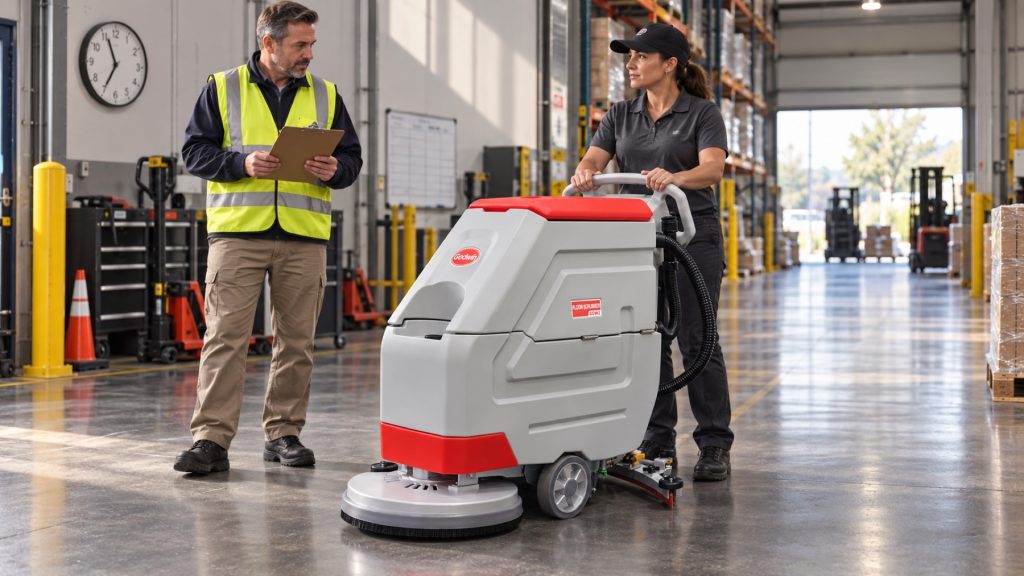

I see how a battery comparison can miss the real problem: a scrubber that cannot finish its route. I start with the cleaning schedule.
Choose a floor scrubber battery by matching verified working time, available charging windows, maintenance resources, and the machine鈥檚 approved configuration. Compare flooded lead-acid, AGM, gel, and lithium options separately, then verify the complete battery-and-charger package against the actual cleaning route.
For a lithium vs lead acid floor scrubber comparison, the useful question is whether the proposed system can complete your work repeatedly. A chemistry label alone cannot answer that. The following framework helps buyers turn a general preference into a configuration request that a supplier can verify.
How Long Must the Scrubber Work Between Charging Windows?
I would not start with the biggest battery. An unclear route can hide the real workload, so I first separate cleaning time from other tasks.
Record the longest cleaning period between permitted charging opportunities, then list travel, tank service, and unexpected delays. Ask for runtime evidence under comparable conditions. The operating requirement is the full route and its reserve, not the building鈥檚 total area alone.

Build the timetable before comparing battery labels
Start with when the floor becomes available and when it must reopen. Then record the activities within that window. Scrubbing an open aisle, moving between work zones, refilling clean water, emptying the recovery tank, and dealing with blocked access are different tasks. A calendar entry marked 鈥渃leaning shift鈥� does not show how long the machine actually draws working power.
For a purchasing discussion, I would bring a route log from representative days. Include a busy day if the machine must handle that day without a backup. Mark the longest uninterrupted section and any breaks when charging is genuinely possible. A lunch break on the staff rota is not automatically a charging opportunity if the machine is far from its approved charging location.
| Schedule detail | What to record | Why it changes the comparison |
|---|---|---|
| Required route | Zones and cleaning acceptance standard | Defines the work that must be completed |
| Longest working block | Cleaning and powered travel between charge windows | Establishes the continuous operating requirement |
| Service interruptions | Tank filling, emptying, and routine cleanup | Separates elapsed time from working time |
| Charging access | Actual available windows and shared equipment | Tests whether the plan is practical |
| Unusual workload | Extra passes, blocked routes, peak days | Identifies the reserve that needs verification |
The route log should also describe floor condition and cleaning settings. A demonstration on a smooth, lightly soiled floor cannot establish runtime for a different route with repeated cleaning passes. Ask the supplier to state brush or pad choice, working mode, battery configuration, and how the test ended.
Set a completion standard before judging the result. A machine that travels the route but leaves unacceptable soil has not met the requirement. Likewise, a route that finishes only at the machine鈥檚 discharge limit leaves little room for changing conditions. Ask the supplier to propose an appropriate operating reserve within the approved system limits rather than choosing an arbitrary universal percentage.
Which Lead-Acid Type Is Actually Included in the Quote?
I find 鈥渓ead-acid included鈥� too vague for a useful comparison. It conceals maintenance differences, so I ask for the exact battery type and model.
Flooded lead-acid, AGM, and gel batteries belong to the lead-acid family, but their care and charging requirements differ. Identify the exact product before comparing maintenance effort, charging behavior, and price. A generic lead-acid label does not establish those operating requirements.
Compare named products rather than broad categories
Flooded batteries require electrolyte maintenance, including watering according to their manufacturer鈥檚 instructions. AGM and gel are valve-regulated lead-acid constructions that do not receive routine watering. This distinction matters when deciding who will look after the equipment. Discover lists flooded, AGM, gel, and lithium separately in its floor scrubber battery range.
That does not make a sealed battery free of all care. Inspection, charging, storage, and fault reporting still require a defined process. Treat 鈥渕aintenance-free鈥� as a term whose scope must be clarified in the product documentation. It should not become an instruction to ignore the battery compartment or stop recording charging problems.
| Quoted battery type | Maintenance question | Evidence to request |
|---|---|---|
| Flooded lead-acid | Who will perform the prescribed electrolyte care? | Exact battery manual and maintenance requirements |
| AGM lead-acid | Which AGM product and charging profile are supplied? | Product datasheet and approved charger pairing |
| Gel lead-acid | What charging and storage instructions apply? | Exact gel model documentation |
| Lithium | Which pack, protection system, and charging limits apply? | Approved pack specification and system compatibility |
For each offer, request the manufacturer, full battery model, pack configuration, and charger identification. Keep those details attached to the quotation. If the supplier substitutes a different battery before shipment, require a fresh compatibility and schedule check. Similar case dimensions or a similar capacity figure do not make two products equivalent.
The proposed maintenance plan also needs an owner. A facility with trained staff and an established battery-care process has different practical resources from a small contractor sharing equipment across several sites. Compare what your team can consistently carry out, not what a brochure assumes someone will do. Where the required care cannot be supported, ask for another approved configuration and compare its complete cost.
Can Short Breaks Provide Enough Approved Charging Time?
I would not count every break as recovered runtime. A charging claim without starting conditions can mislead, so I ask what that break actually restores.
Short charging breaks help only when the exact battery, charger, and scrubber support that charging pattern. Obtain the permitted procedure and charge-time evidence for the proposed package. Neither lithium nor lead-acid chemistry alone establishes how much useful work a brief charge can add.
Ask for the conditions behind a charging claim
Opportunity charging means using suitable breaks to charge between working periods. It should be an approved part of the operating plan. Some lithium products are designed for this use, and some advanced AGM products also support it. Trojan鈥檚 comparison of flooded, AES AGM, and lithium batteries illustrates why a simple 鈥渙nly lithium can do this鈥� rule is misleading. That comparison describes Trojan products, not every battery on the market or a GODWIN configuration.
Ask the supplier to show the state of charge at the beginning and end of the proposed charging window. Request the charger model, input conditions, temperature range, and any restrictions on repeated partial charging. 鈥淔ast charging鈥� without those details is not a working timetable.
Distinguish a full recharge from restoring enough energy for the next task. A charge-time figure may describe a particular starting state rather than an empty-to-full cycle. If two offers use different starting conditions, their headline times are not directly comparable. Ask both suppliers to address your same starting condition and next working block.
For a split-shift operation, write the sequence in plain language: first route, approved charging break, second route, then the required end-of-day charging or storage process. Have the supplier review the whole sequence. A successful first shift does not prove that the energy balance remains workable over successive days.
Check the physical reality of the break too. The operator needs time to reach the charging location and follow the approved procedure. Shared charging access can reduce the window. Use the separate floor scrubber charging-area planning guide to organize the location questions for site review. This battery comparison establishes the information needed to assess the schedule. Never improvise a different charger or charging procedure to make a timetable appear feasible.
Why Can Similar Capacity Figures Produce Different Working Times?
I would not promise runtime from an amp-hour number. It leaves important conditions unstated, so I compare the documented battery system and route together.
Capacity figures describe a battery under stated rating conditions; they do not directly predict a scrubber鈥檚 working time. Compare voltage, capacity rating basis, permitted usable energy, operating load, and temperature. Then require a representative route test with the proposed machine, battery, and charger configuration.

Keep the energy specification separate from the runtime result
An amp-hour figure needs its voltage and rating conditions to become useful purchasing information. Multiplying nominal voltage by amp-hours gives nominal watt-hours, but nominal energy is not a guarantee of usable energy at the machine. The approved discharge limits, battery condition, and actual load still matter. For a GODWIN quotation, request working-time evidence for the actual proposed configuration and stated test conditions. A catalogue number alone does not establish what the machine will achieve on your route.
Ask the supplier to state how capacity was rated. Discover鈥檚 published floorcare battery data, for example, lists different amp-hour values at different discharge-rate conditions for some lead-acid products. The lesson for a buyer is to compare like with like, rather than selecting the largest printed number from unlike specifications. See the manufacturer鈥檚 floorcare battery specifications.
Next define a representative trial. Record the machine and battery identities, starting indication, cleaning mode, floor and soil conditions, route, and charging history relevant to the test. Note stoppages separately. The test should finish at a planned operating endpoint consistent with the manual; it should not intentionally drive the battery beyond its permitted limit.
Record cleaning quality as well as elapsed time. Changing brush pressure, speed, or cleaning method solely to extend the demonstration may produce a result that does not meet your normal standard. The trial is useful when its conditions reflect the work you intend to repeat.
For an existing machine with reduced working time, first establish what changed. Route changes, different cleaning settings, charging faults, or battery condition may require different responses. Provide operating records and fault indications to the service team. Do not assume that moving to another chemistry will resolve every cause of short runtime, and do not open or test electrical components without the required competence and approved procedure.
What Makes a Battery Replacement Compatible With the Scrubber?
I would pause a replacement based only on matching voltage. An incomplete match can create problems, so I ask for approval of the whole system.
A replacement needs approval for the complete scrubber system, including the battery pack, charger, controls, protection, physical installation, and operating limits. Matching voltage or dimensions alone is insufficient. Obtain written compatibility confirmation for the exact machine configuration before ordering a replacement or chemistry conversion.
Request a documented configuration decision
Start with the scrubber model and identifying information, then supply the existing battery and charger labels through a safe, non-invasive record. If obtaining a photograph requires removing a cover or entering a hazardous area, let authorized personnel handle it. The aim is to give the supplier an accurate equipment identity, not to perform an improvised inspection.
Ask the manufacturer or responsible technical provider to identify the approved replacement package. The answer should account for mounting, weight requirements, electrical protection, machine controls, charge indication, and any required communication between components. A chemistry conversion can change more than the energy storage device. Do not treat a pack described as 鈥渄rop-in鈥� as machine-specific approval.
Battery manufacturers also distinguish compatibility work from selecting a battery by chemistry. Discover describes compatibility assessment and charger guidance as part of its lithium integration support. Trojan provides separate battery and charger documentation. These resources reinforce the need to verify the proposed system; they do not approve a conversion for a GODWIN machine.
For GODWIN equipment, request confirmation against the actual order or serial configuration. Ask for the battery chemistry, charger identification, and approved replacement details for that specific configuration; do not assume the same package applies across all scrubber models. A claim about a different model, an older webpage, or another delivered order cannot fill that gap.
Keep the confirmation with the purchase record and make any approved commissioning requirements part of the handover. Ask how future replacement parts will be identified if the battery supplier changes. This article does not provide wiring, charger programming, or battery conversion instructions. The delivered approved manuals, labels, manufacturer directions, and applicable local requirements control those activities.
How Should Buyers Compare Battery Costs Before Placing an Order?
I would not choose from battery price alone. Missing service and downtime assumptions can distort the comparison, so I put both offers on the same basis.
Compare complete approved packages over the same intended ownership period and cleaning workload. Include charging equipment, necessary service, maintenance labor, replacement assumptions, and downtime arrangements. Use documented terms and clearly labeled estimates; no battery chemistry has a universal payback period or guaranteed service life.

Put uncertain costs where the buyer can see them
Begin with what each price includes. A battery-only quotation and a complete machine package are different purchases. Confirm the charger, any approved installation or commissioning work, required documentation, and the agreed delivery scope. Compare the same currency and commercial basis so freight or tax assumptions do not disappear inside a headline price.
| Cost item | Request or calculate | Comparison boundary |
|---|---|---|
| Initial package | Machine, battery, charger, approved installation scope | Compare equivalent supplied packages |
| Routine care | Required tasks, staff time, consumables | Use the actual battery manual and local labor cost |
| Energy | Measured or documented consumption for the duty | Keep test conditions and tariff assumptions visible |
| Replacement | Approved replacement quote and planning scenarios | Do not substitute a generic cycle-life claim |
| Downtime | Backup arrangements and service terms | Distinguish agreed support from buyer assumptions |
| Warranty | Written coverage, exclusions, and claim procedure | Confirm the exact product and order scope |
Build a range of ownership scenarios if replacement timing is uncertain. One scenario can assume the battery lasts for your intended holding period; another can include an earlier replacement at a quoted cost. These are planning cases, not forecasts. Their purpose is to show whether a purchasing decision depends heavily on an unverified lifespan claim.
Ask for the conditions behind any cycle-life figure used in the offer, including discharge depth, temperature, charge procedure, and the capacity threshold used to define end of life. A laboratory cycle claim and calendar service at your facility are different evidence. Warranty wording also needs its own review rather than being inferred from an advertised number.
Finally, return to the schedule. An economical package must complete the required route with a workable care and charging plan. To discuss a GODWIN floor scrubber configuration, send the model or intended application, route length or area, longest working block, charging windows, destination, and available battery-care resources. Review the GODWIN equipment range alongside that request, and ask for written confirmation of the exact battery-and-charger package before ordering.
Conclusion
Match the battery to the route, charging windows, and care resources. Confirm the complete approved package, then compare documented performance and costs under the same working conditions.


 English
  Español
  Français
  العربية