 Skip to content
A pallet truck can meet its rated capacity yet fail to enter a daily pallet. A bottom board, load wheel or overhanging load can stop the route.
Measure the actual pallet from the intended entry side: outside size, usable fork pockets, underside structure, lowest clearance and loaded envelope. Compare those measurements with the proposed truck's exact fork, wheel and lowered-height drawing, then verify entry and travel with a representative approved pallet.

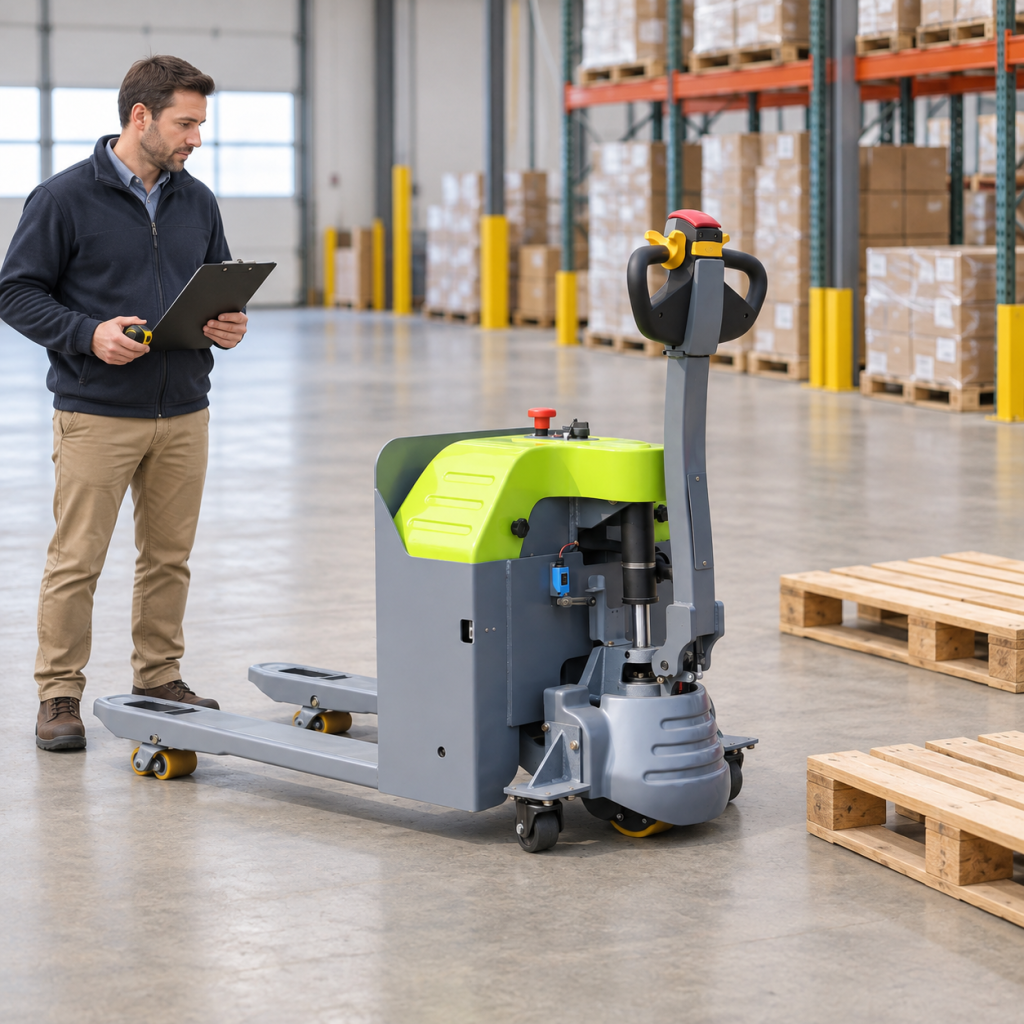
Illustrative scene generated from a real pallet-truck product reference; it is not a record of a GODWIN customer test.
Which pallets should be measured before requesting a quote?
One supplier's nominal pallet size may hide a smaller opening on another supplier's pallet. Build the sample set before comparing trucks.
Sample every pallet family the truck must handle, especially the smallest usable openings and worst recurring load. Distinguish receiving pallets from pallets kept for internal storage, and mark the operator's actual entry direction. An average pallet dimension can hide the exception that causes daily stoppages.
Start in the work area, not in a product catalogue. Ask receiving staff which pallet types arrive from suppliers, whether damaged pallets are rejected or repaired, and which ones must travel to production, storage or dispatch. A wooden pallet, plastic pallet and metal stillage may have the same nominal footprint but different entry openings and underside reinforcement. A four-way pallet may have different clearances on its long and short sides.
Choose a clean, sound example of each approved type. Add one example representing normal wear only if it remains within the site's acceptance standard. The purpose is not to make a truck accommodate unsafe, broken pallets; it is to learn the variation in pallets that operations legitimately use. Identify each sample with a code and photograph the entry face, side profile and underside while the pallet is empty and stable. Do not lift a pallet to take a photograph from beneath it.
Record the heaviest regular load and the most awkward load shape separately. A long carton or drum may overhang even if the pallet itself fits the forks. The OSHA guidance on load handling emphasises stable loads and operating within the truck's rated capacity. For buyers outside the United States, treat the OSHA page as a technical reference and apply your local rules and the manufacturer's instructions.
| Sample record | Capture for each approved pallet type | Decision it informs |
|---|---|---|
| Pallet identity | Material, supplier/use area, sample photo | Whether one configuration serves the whole fleet |
| Outside footprint | Length and width; intended entry side | Fork length, turning envelope and storage fit |
| Load envelope | Actual weight, overhang and orientation | Capacity and route clearance |
| Condition standard | Sound, accepted wear, rejected damage | Which sample is valid for a site trial |
This article focuses on dimensional compatibility. Battery, duty cycle, service and commercial terms also matter when choosing a truck, but none of those factors can replace a pallet measurement pack for your site.
How should entry openings and bottom boards be measured?
Outside dimensions look compatible until a wheel meets a bottom board. Measure the space the fork and wheel actually pass through.
Measure the clear opening where the forks and load wheels will actually travel, not just the distance between the pallet's outer edges. Note the lowest clear height, the usable width between blocks or stringers, the depth of the pocket, and any bottom boards or fasteners that cross the entry path.
Place the empty pallet on a flat floor in its usual orientation. Use a tape and, if needed, a straightedge to identify the narrowest part of each approved entry opening. Write down whether you are measuring a centre opening, a side opening, or a face that is not intended for entry. Photograph the tape at the restriction, but take the numeric reading in person; photographs can distort perspective.

Illustrative opening comparison generated from a real product reference; measure the actual pallets used onsite.
For a block pallet, map the blocks and bottom boards so the proposed load wheels have a route. For a stringer pallet, record whether the stringer is notched and how much clear space is available. Plastic pallets may have moulded ribs that are less obvious in an overall photo. The pallet must be assessed in the form used on site, including any added slip sheet or bottom reinforcement approved by the warehouse.
Check more than one sample if the type varies. A pallet stored outdoors may swell or warp; repair boards may be thicker than the original boards. If the accepted variation is large, record a minimum observed opening rather than only a nominal catalogue dimension. Do not invent a “universal safe tolerance.” The supplier needs the exact measured restriction and its own truck drawing to decide whether adequate clearance exists.
| Entry measurement | Where to take it | What can make the reading misleading |
|---|---|---|
| Clear opening height | Floor to lowest board or rib at the entry | Uneven floor, sagging or replacement board |
| Clear opening width | Between blocks or stringers on the chosen face | Pallet skew or a protruding fastener |
| Pocket depth | Along the intended fork path | Cross boards hidden deeper inside |
| Wheel path | Under the areas where load wheels will roll | Rib, nail or base block after the fork tip |
An easy check is to draw the fork path on a copy of the underside photo. This is a planning aid, not a substitute for a dimensional drawing or a controlled trial. If your operation rotates pallets between areas, repeat the check for each entry direction.
Which truck dimensions must match the pallet measurements?
Catalog fork length alone cannot show whether the load wheels pass the blocks. Ask for the whole lowered-fork geometry.
Request a drawing for the exact quoted truck showing fork length, width and outside spread, lowered fork height and load-wheel position. Match each value to the corresponding pallet opening and load orientation. A model name or “standard fork” does not identify one universal geometry.
The most common comparison mistake is pairing unlike dimensions. Fork outside spread is measured across the outer fork edges; a pallet opening may be measured between internal obstructions. Fork length is not the same as total truck length. Lowered fork height is important at the entry, while raised travel height affects bottom-board clearance after pickup. Ask the supplier to label its drawing so each term has one meaning.
The location of load wheels can matter as much as the fork tips. A fork may start into a pallet smoothly, then meet a transverse board as the wheels approach. The required fork length also depends on pallet depth in the direction of entry and how the load is supported. A fork projecting too far beyond a pallet can create a separate hazard near adjacent stock; a fork that does not support the load as required is also unsuitable. These are reasons for checking the complete arrangement, not for choosing a fork length from a generic chart.

Illustrative view of the wheel path, not a dimensioned fit drawing.
Manufacturer documents illustrate how configuration-specific these values are. A Crown pallet-truck specification sheet uses dimensioned views and option notes rather than a single universal pallet fit claim. It documents Crown equipment, not GODWIN equipment. For a GODWIN inquiry, request the current drawing for the exact proposed model and fork option; website model tables alone may not show every entry-critical dimension.
| Truck dimension to request | Match to pallet evidence | Ask for clarification if… |
|---|---|---|
| Outside fork spread and individual width | Clear entry path on chosen face | The quote says only “standard forks” |
| Lowered fork height | Minimum opening height | The drawing omits wheel or tip detail |
| Fork length and load-wheel position | Pallet depth and underside obstructions | Only overall truck length is supplied |
| Maximum permitted load and load centre | Actual loaded pallet | Capacity is quoted without configuration |
The GODWIN pallet-truck range is a starting point for available equipment types. Use a model-level drawing and written configuration confirmation for the final fit check.
What changes when the pallet carries its normal load?
An empty pallet can enter cleanly while its regular load overhangs a doorway or moves the centre of gravity. Check both states.
A loaded pallet may sag, shift or overhang, so the empty-pallet fit check cannot approve the full task. Record the load's real weight and footprint, then observe the pallet, fork support and floor clearance during a controlled trial using a stable, approved load within the truck's rated limits.
Start with the load that operations actually moves often, then separately consider unusual approved loads. Weigh or document the load from reliable order or production records; do not infer it from the number of cartons. Photograph how the goods sit on the pallet and whether their centre is offset. Include any wrap, banding or corner protection that affects the outer envelope.

Illustrative load-recording scene; no capacity or clearance is implied.
Once the load is on the pallet, its bottom deck may sit lower. A pallet that cleared the lowered forks while empty might drag when transported. Conversely, raising a pallet farther simply to escape a floor defect is not a buying strategy; the operator should follow the manufacturer's permitted travel position and the site traffic rules. Measure the floor defect and ask whether the route is suitable for the proposed equipment.
In a trial, the authorised operator should pick up the pallet, bring it to the permitted travel position, and move through a representative route at the site's normal controlled pace. Observers stay outside the travel path. Stop if a bottom board catches, the load shifts, the truck exceeds its permitted rating, or visibility becomes unacceptable. Record the failed point and the exact sample rather than describing the whole test as “almost suitable.”
Pallet overhang changes a turn as well as a straight run. The truck's listed turning radius does not necessarily describe the outer path of an offset, oversized load. Compare the combined truck-and-load envelope with the narrowest doorway, rack end and crossing. A nominal pallet footprint alone is insufficient for that check.
How should buyers check a mixed-pallet route?
The pallet can fit the forks and still fail at a dock or doorway. Follow the full route with the representative load.
Trace each pallet family's real journey: pickup, doorway, aisle, turn, dock or storage position, and return. Record the narrowest usable width and any threshold, slope or damaged surface. The proposed truck must fit the approved pallet and complete the route, not just enter it in an open demonstration area.
A warehouse often handles more than one pallet but uses only one main route. That can make a mixed-pallet trial manageable: identify the smallest opening, longest load and tightest turn, then check whether one candidate handles all three. If those worst cases belong to different tasks, test them separately. Do not combine measurements from different routes into a fictitious “typical” route.
At a doorway, record the clear width with doors fully open and note guards, posts and stored goods that reduce it. At a turn, mark the actual usable floor area and whether pedestrians cross. At a dock, note the transition, dockboard and vehicle-restraint process. The OSHA workplace guidance for powered industrial trucks identifies surfaces, ramps and overhead restrictions as important conditions. The UK HSE traffic-route guidance likewise treats route layout and surface condition as workplace design issues. Apply the rules relevant to your location.

Illustrative doorway survey, not an actual site measurement.
Write down operational timing. A route may be clear during a morning demonstration but obstructed when inbound pallets queue. Photos of both the clear and normal busy condition give the supplier useful context. Where the site has a recurring threshold or a sloped approach, obtain the exact truck manufacturer's operating limits for the proposed load and surface; do not use a generic gradeability figure from another model.
A route check is also a chance to decide whether the work should be split. If one pallet family requires a very different fork geometry, a separate handling method or a controlled pallet standardisation project may be more practical than asking one truck to do incompatible tasks.
What should a buyer send for a precise pallet-truck quote?
A request for “standard forks” leaves the supplier guessing about the entry pocket. Send measured samples and the route constraints together.
Send the supplier a labelled pallet register, dimensioned entry and underside photographs, loaded-weight evidence, route measurements and the required duty. Request the exact fork and wheel drawing, rated-capacity information and a written statement of which pallet samples the proposal covers.
One page can list each pallet sample's outside size, entry face, smallest opening and underside structure. A second page can show the route, load and work schedule. Attach photographs referenced by sample code rather than a folder of unlabelled images. State whether the equipment is for indoor floor transport, dock work or another approved task; do not ask the supplier to infer that from a photo.
The reply should make its assumptions visible. Which entry direction was used? Which fork spread and length are quoted? What wheel arrangement is supplied? Is an option being proposed or is it part of the standard build? Which sample still needs a site test? A precise quotation can contain open questions, but it should not silently convert an unknown measurement into a promise of fit.
Use the same pack at delivery. Compare the received fork and wheel arrangement with the signed quote and the trial record. Recheck a representative pallet before the truck enters routine work. If the warehouse later changes pallet supplier or pallet design, the compatibility check should be repeated rather than assuming the old result remains valid.
Send the measurements through the GODWIN contact page so the proposed configuration can be checked against your pallets and route. If the task includes placing loads into racks rather than floor transport, ask separately about stacker forks, support legs and the required lifting height.
Conclusion
Good pallet-truck selection begins with the pallet you actually use. Measure its usable openings and underside, match them to the exact truck drawing, then test the loaded pallet through the real route. That evidence gives the supplier a clear question to answer and gives the buyer a repeatable delivery check.


 English
  Español
  Français
  العربية