 Skip to content
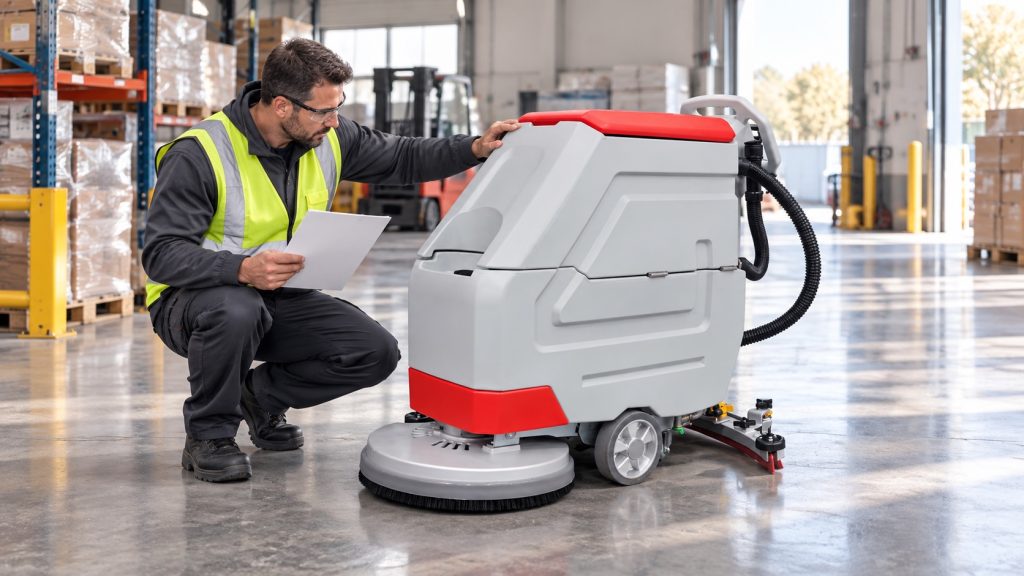

I have seen a checklist become hard to use when it mixes a quick operator check with repairs that require a technician.
A floor scrubber maintenance checklist should identify the exact machine, confirm safe visible condition before use, record cleaning and draining after use, and route abnormal findings to qualified service. Follow the delivered manual for intervals and procedures; use model and serial information before selecting replacement parts.
The most useful checklist is one an operator can complete honestly. It names the observable condition, the allowed action, and the person responsible for the next decision.
What Should Operators Check Before Each Shift?
I want a short start-of-shift record that catches an unsafe or unusable machine before it enters a busy cleaning route.
Before use, identify the machine and inspect only accessible external conditions: visible damage or leakage, tank levels, brush or pad area, squeegee, hose connections, controls, and battery indication. Stop for conditions the delivered manual does not authorize the operator to address.

Put the model, serial number or fleet identifier, date, operator, and site on the record. These details matter when several machines look alike or use different batteries, brushes, chargers, and maintenance instructions. A generic form without machine identity cannot reliably support later service or parts decisions.
Park according to the delivered instructions before inspection. Look around the machine for liquid, unusual wear, loose external items, damaged cables, and anything that appears different from its normal condition. Do not reach into moving parts or remove protected covers as part of a quick operator check. If there is smoke, heat, burning odor, exposed conductors, uncontrolled movement, or liquid ingress, isolate the equipment according to site procedure and refer it to qualified personnel.
Check the recovery tank level and whether its lid, visible seal, and drain cap appear secure. Confirm that the suction hose is visibly connected and not crushed. Look for debris at the rear squeegee and for obvious tears or distortion in accessible rubber edges. These observations support the water-pickup troubleshooting guide without assuming that every water trail has the same cause.
Check the solution tank level and accessible brush or pad area. A floor scrubber should not be sent into work with a known empty solution tank, a visibly damaged brush, or wrapping material caught around the deck. The approved brush, pad, and chemical combination still depends on the floor, actual model, and manufacturer guidance. Do not infer compatibility from color or from a similar machine.
| Before-use item | Observable question | Record or next step |
|---|---|---|
| Machine identity | Do model and fleet or serial details match the task? | Record identity and obtain the correct manual |
| Visible condition | Are there leaks, damage, unusual heat, odor, or loose external parts? | Stop and escalate serious findings |
| Tanks and lid | Are levels suitable and accessible closures secure? | Refill or empty only as authorized |
| Brush or pad | Is accessible debris present or wear obvious? | Remove only accessible debris under the manual; flag replacement |
| Squeegee and hose | Are visible edges, connections, and routes intact? | Clean accessible debris; flag damage |
| Controls and battery | Are indicators normal for the planned shift? | Record warning and use only the approved charger |
The check ends with a clear decision: ready, ready after a permitted correction, or out of service. An unexplained tick box is less valuable than a short note describing what was seen and who received the report.
What Should Be Cleaned After Each Use?
I would rather remove wastewater and trapped debris after a shift than let the next operator discover odors or weak pickup.
After use, follow the delivered manual to drain and clean the recovery tank, rinse accessible wastewater paths, remove approved-access debris from brushes or pads and the squeegee, and park or charge the machine correctly. Dispose of wastewater only through the site's approved route.

Begin with the machine safely parked and switched off in the manner specified by its manual. The recovery tank contains wastewater, soil, and possibly cleaning chemical residues. Take it to the facility's approved disposal point. A nearby floor drain is not automatically suitable for the actual waste stream. Site rules and local requirements determine the disposal route.
Empty and rinse the recovery tank and any accessible strainer or service filter that the manual identifies for operator cleaning. Check the lid and visible sealing surface for retained grit. Clean the drain hose and cap as directed, then return them to their specified positions. Do not use high-pressure water on the machine or direct water into electrical areas.
Remove loose material from the squeegee assembly and inspect the rubber edge. Packaging film, string, or grit can interrupt water pickup even when the vacuum system is otherwise operating. If a blade is torn or worn, record the finding and obtain an approved replacement identified for the exact machine. The checklist should not prescribe a universal blade-flipping or replacement interval without the applicable documentation.
Inspect the brush or pad area for wrapping material and residue only where access is permitted by the delivered manual. Do not force a component off or reach into an energized deck. The use of a brush or pad on a different floor, or replacement with a different type, calls for compatibility review rather than a guess based on appearance.
Kärcher's commercial cleaning machine care guide emphasizes that scrub heads, squeegees, suction hoses, and dirty-water tanks contact wastewater and need systematic care. That is useful general context. The specific steps for a GODWIN machine must still come from its delivered instructions and actual layout.
Finish by documenting the after-use condition. Note anything the next operator needs to know: water trail, weak flow, unusual noise, damaged rubber, warning indication, or missed cleaning. A shift log can reveal repeated symptoms that a one-time clean-down does not explain.
| After-use item | Operator action within the delivered manual | Exception to record |
|---|---|---|
| Recovery tank and drain | Empty, rinse, check accessible seal and return drain parts to their specified position | Retained debris, leakage, odor or damaged closure |
| Squeegee and suction path | Remove accessible debris and inspect visible rubber and hose connections | Torn edge, blockage or repeated water trail |
| Brush or pad area | Remove permitted-access wrapping material and surface residue | Damage, abnormal wear or uncertain fit |
| Parking and charging | Park safely and use only the identified approved charger and site procedure | Warning, heat, damage or charging mismatch |
How Should Battery Care Be Recorded?
I do not want a universal charging line on a checklist when the fleet may contain different batteries and chargers.
Record the delivered battery and charger identity, state or warning indication, charge location, and whether the approved charging procedure was followed. Battery care depends on the exact system. Do not prescribe watering, equalization, opportunity charging, voltage checks, or replacement from a generic scrubber checklist.
The current GODWIN floor scrubber catalogue does not establish one battery chemistry or charger package for every model and order. The quotation, nameplate, battery label, charger label, and delivered instructions must identify the actual configuration. A checklist can ask the operator to confirm that those records are available; it cannot fill the missing information with an assumed 24 V lead-acid or lithium system.
Before connecting a charger, inspect for the external hazards named in the delivered instructions. Hot, swollen, wet, damaged, or odorous batteries and visibly damaged leads need qualified assessment. Do not improvise another charger because the connector appears to fit. Do not bypass protective devices or open battery assemblies as an operator maintenance task.
Record when the machine is connected and when it is released for work if the facility needs a charging history. This can help explain a short shift later, but a dashboard indicator alone is not a capacity test. Keep the charging record linked to the route and machine identity.
Flooded lead-acid, AGM, gel, and lithium systems have different care requirements. Any electrolyte work, charging profile change, diagnostic measurement, or battery replacement requires the exact manufacturer's instructions and appropriate competence. The battery selection article explains why chemistry names and amp-hour labels cannot prove real route performance.
The charging location also matters. Record whether access, supply, and site controls remain as approved. The charging-area planning guide covers what the facility should verify. If the operating schedule changes, the battery and charger plan should be reviewed rather than silently stretching the old routine.
Which Findings Need Qualified Service?
I draw a clear line when a routine check finds an electrical fault, damaged component, or symptom that remains after a permitted cleaning step.
Escalate damaged wiring, abnormal heat or odor, liquid ingress, uncontrolled motion, persistent warning codes, suspected motor or charger faults, and replacement-part questions. Record symptoms and external evidence. Qualified personnel should diagnose protected electrical, mechanical, and control systems using approved machine-specific information.

The checklist should tell the operator when to stop. A condition that could affect motion control, charging safety, electrical integrity, or water containment should not be handled by repeated restarts. Isolate the machine under site procedure, keep people away from the affected area, and report the issue with the machine identity and visible indicators.
Some low-risk checks are supported by the applicable GODWIN common or series manuals. For weak pickup, these include checking a full or foamy recovery tank, visible squeegee debris, hose connection, and accessible filter where the physical machine matches the manual. For low solution flow, these include solution level, labeled valve position, and an accessible removable filter after the specified preparation. These checks do not authorize opening motors, protected electrical enclosures, or a pump or solenoid circuit.
When the actual controls or components differ from the manual, stop and obtain the correct delivered documentation. Similar model names are not enough to transfer a procedure. The current product knowledge does not supply a universal parts or compatibility matrix for all GODWIN scrubbers.
| Finding | Operator record | Service boundary |
|---|---|---|
| Repeated water trail | Route, photo, tank level, visible squeegee and hose condition | Persistent or damaged component needs diagnosis |
| Low solution flow | Tank level, valve position, accessible filter condition, detergent used | Pump, solenoid or internal line work needs qualified review |
| Short working time | Start/end indication, route, load, charge record | Battery, charger and control diagnosis needs system data |
| Unusual noise or motion | When it occurred, location, warning display and video if safe | Stop use; do not bypass an interlock or drive fault |
| Damage, heat or odor | External photo and immediate response taken | Isolate and follow site emergency and qualified-service procedure |
| Replacement item | Model, serial/order data and damaged part photo | Match approved parts before purchase or installation |
The company's after-sales process guide explains how to provide useful records and track a case. The checklist supports that process by preserving facts instead of guessing at a root cause.
How Often Should Deeper Maintenance Be Scheduled?
I resist copying fixed weekly or monthly intervals from another brand or machine because they may not match the delivered configuration.
Use the maintenance schedule in the applicable delivered manual for each machine and adapt the work plan to actual duty, soil, floor, and site conditions. Record the responsible person, due trigger, completed task, findings, and next date. Only authorized personnel should perform tasks beyond operator care.
Start with the manufacturer's schedule and the facility's own service agreement. The interval may be expressed in hours, days, shifts, or another condition. Record whichever trigger the manual uses. A calendar reminder is useful, but it should not silently replace an operating-hour requirement or a condition-based inspection.
Create separate entries for operator care, supervisor review, and qualified service. Operators may clean accessible tanks, brushes, and squeegees within the manual's instructions. A supervisor may audit completed records, recurring faults, and stock of approved consumables. Technical work may require specialized access, tools, isolation, and approved parts information.
Use the machine's actual duty to review the schedule. A scrubber operating in a dusty warehouse, a lightly used corridor, and a multi-shift facility may show different soil loading and consumable wear. The review should support more frequent inspection when conditions justify it, while leaving prescribed service actions and limits under the manual and competent personnel.
Tennant's equipment maintenance guidance directs users to the operator manual's maintenance chart for the correct schedule. It mentions squeegees, vacuum screens, and hoses as routine areas of attention. Those are general examples, not universal GODWIN replacement periods.
Look for patterns in the log. Repeated water pickup problems after cleaning, recurring low flow, unusual battery warnings, or the same damage at one site may require a process or technical review. Do not respond by inventing a fixed replacement interval or declaring a root cause from the checklist alone.
What Information Makes the Checklist Useful for Support?
I want the maintenance record to help the next operator and the service team, not merely show that someone ticked every box.
Record machine identity, date, operating context, observed symptom, permitted action, outcome, photos or video when safe, and the person who owns follow-up. Link each unresolved item to a service case or handover note. Close it only after the approved action and result are documented.
Write observations in ordinary language. “Water trail at left side of rear squeegee after turning” is more useful than “machine bad.” Include the zone, floor condition, approximate point in the shift, and any warning shown on the machine. Record what was actually done, such as emptying a full recovery tank or removing visible squeegee debris, and whether the symptom changed.
Photograph external conditions safely. A wide view shows the machine and location; a close view shows the visible defect or display. Do not ask an operator to remove a guarded cover, reach under an energized machine, or expose battery terminals solely to create a service photo.
Keep manual, configuration, and parts records connected to the fleet identifier. The company's formal after-sales process calls for model, serial number, configuration, environment, sequence before the fault, and photos or video when opening a case. The supplier, technical team, and buyer can then review the same evidence.
Assign an owner and status to every exception. “Reported to service” is an intermediate state, not closure. Record whether the machine is isolated, who is reviewing it, what approved action was taken, and who confirmed the result. If a part is replaced, capture the approved part identity and the relevant order or serial configuration.
Review the checklist periodically for usefulness. Remove boxes that nobody can verify, and clarify questions that produce inconsistent answers. Keep the core record short enough for routine use while allowing an exception note when a real problem occurs.
Conclusion
Use the delivered manual to define each task. Keep operator checks clear, record exceptions precisely, and route technical faults to qualified service.


 English
  Español
  Français
  العربية