 Skip to content
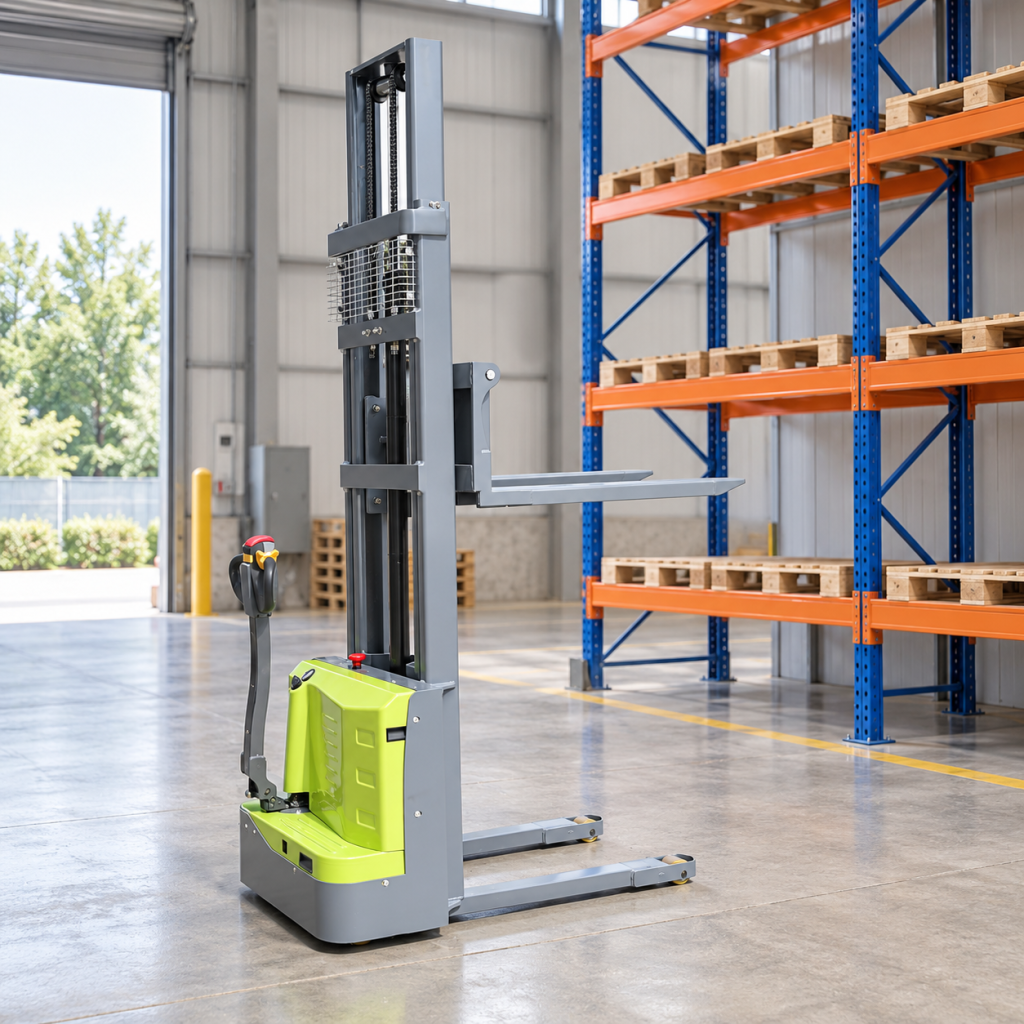
A rack beam may be reachable on paper while the pallet still cannot be placed and the forks withdrawn cleanly.
Select lift height from the complete placement task, not the rack's advertised height. Measure each receiving level and pallet, establish the fork elevation needed to clear the beam, then compare that requirement with the exact stacker mast option. Confirm the loaded task and available overhead space separately.

Illustrative rack-planning scene generated from a Jinge company photograph. It is not a measured installation or proof of a successful placement.
Which height on the rack should you actually measure?
“Our rack is three metres high” does not tell a supplier where the forks must go.
Identify the highest position and measure from the finished floor to the surface supporting the pallet. Record the beam, pallet and load geometry for that bay. The required fork height lets the pallet clear its support during approach and settle onto it without a forced maneuver.
Start with a rack drawing if one exists, but check the installed rack. A drawing may show nominal beam elevations while the floor has a slope, a replacement beam is at a different hole position, or a particular bay has a protector or sprinkler obstruction. Label the aisle, bay and level so a later supplier drawing can be matched to the exact task. If more than one pallet style is used, do not let the easiest pallet define the requirement for all of them.
Measure the support surface, not only the beam's outer top edge. Depending on the rack and pallet, the pallet may rest on beams, decking or another approved support. Record where the pallet actually bears and the height of the part of the pallet that must pass over that support. The fork elevation needed for a loaded pallet is not automatically equal to the beam elevation: pallet construction, fork engagement and the clearance needed to move without scraping all affect the approach.
Make a simple side-view sketch of the actual pallet at the intended level. Mark floor, support surface, pallet bottom, fork position and any rack member above. The sketch is a request for the supplier and site engineer to check, not a substitute for their approved rack and truck instructions. It helps prevent a common misunderstanding in which the buyer gives a beam elevation and receives a truck whose forks can reach that elevation only with no usable placement margin.
| Site item | Record from the actual bay | Why it changes the question |
|---|---|---|
| Receiving level | Aisle, bay, level and floor-to-support elevation | Identifies the real destination rather than a nominal rack height |
| Pallet | Type, entry side, underside and bearing arrangement | Changes where forks sit and what must clear the support |
| Load | Height, stable footprint and known weight source | Can create a separate overhead or capacity limit |
| Rack opening | Beam, decking, upright and overhead obstacles | Determines whether approach and lowering are possible |
| Placement margin | Supplier/site-agreed clearance for entry and set-down | Prevents selection at the absolute geometric limit |

Illustrative survey scene. The blank sheet and visible rack are not a site measurement record.
Photograph the level with a tape or other approved measuring method visible only when it is safe to do so; note the reference point and date. If the rack has not yet been installed, mark all elevations as design assumptions. A purchasing decision can proceed conditionally, but the unverified site dimension should remain open in the quote rather than quietly becoming a fact.
How does the pallet change the fork elevation needed for placement?
Two pallets offered to the same rack can demand different fork paths.
Check the pallet's actual fork openings, underside boards, orientation and bearing points. Then trace the loaded pallet from approach, over the support, down to its resting position, and out again with the forks. The highest fork position in that sequence is the lift-height requirement to verify.
A stacker lifts the pallet on its upper forks; its lower support legs remain on the floor. The relationship between those parts matters, but the placement height is determined by the upper lifting forks and the pallet they support. On one pallet, the forks may enter beneath a top deck with generous clearance. On another, thick bottom boards or a different entry side may put the lifted pallet at a different height relative to the fork top. Record the specific pallet family rather than applying one generic “pallet thickness” allowance.
The move includes more than reaching the beam. The pallet must arrive without striking the rack, move far enough onto its approved support, lower until the load is carried by the rack, and release the forks without lifting or dragging the pallet back out. A candidate stacker that just reaches a theoretical level at maximum extension may leave no practical room for this sequence. The right allowance depends on pallet condition, fork geometry, rack design and operating instructions; there is no universal centimetre value to add to every site.
Check the approach direction too. If the bay can only be entered from one side, the operator cannot solve a clearance problem by rotating the pallet or changing entry direction without first confirming that the pallet, load and rack permit it. A pallet that protrudes beyond the beam may be normal for a particular approved rack design, but the team should identify its intended bearing points and allowed overhang from rack documentation. Do not infer structural suitability from a photograph or an empty-pallet trial.
In the United States, OSHA's powered industrial truck load-handling guidance emphasizes proper fork positioning and secure support of the load. That guidance is useful for framing the task; the specific stacker, pallet and rack instructions still control the actual placement method. If a pallet is damaged or the load unstable, replace or correct it rather than treating an awkward lift as proof that a taller mast is needed.
Why is the catalogue's maximum fork height only a starting point?
A printed maximum tells you the truck's upper travel limit under its stated configuration, not the usable height of every rack task.
Ask what the published height measures, which mast and fork arrangement it describes, and whether that exact build can complete your placement sequence below its limit. Compare the measured fork requirement with the option-specific maximum fork height, then check the extended mast and load conditions as separate gates.
Manufacturers may present several dimensions together: maximum fork height, lowered mast height, extended mast height and free lift. These are not interchangeable. OSHA's critical measurements guide explicitly distinguishes maximum fork height from overall raised height and advises considering both to determine whether a lift can be performed with adequate clearance. The term on a sales card should be traced to the manufacturer's actual dimension drawing and rating information for the build being offered.
The GODWIN electric hydraulic lifting stacker page notes that specifications can vary with model, lift height and optional configuration. That means a lift-height value on one page is not evidence for the particular truck pictured in this article or a different mast option. Ask the supplier for the exact quotation revision, model, mast code and drawing, with the measurement reference clearly marked. If the supplier says “three metres,” find out whether that means fork top, fork underside, nominal lifting travel or a different convention.

Illustrative clearance concept. The image contains no measured dimensions and does not certify safe rack access.
Maximum fork height should not be treated as a target operating position. A rack level requiring a fork elevation almost identical to that maximum leaves the purchasing team with little evidence about real pallet variation and controlled set-down. Ask for a dimensioned placement check or a controlled site trial on the intended rack, rather than inventing a universal safety margin. That check must be tied to the pallet and actual offered mast, not simply to a product-family brochure.
This question differs from doorway fit. Lowered mast height concerns access and overhead envelope; a truck may enter the aisle yet still fail to place a pallet at the upper rack. Conversely, choosing the tallest available mast without checking its lowered and raised envelopes can create an avoidable conflict elsewhere in the building. Treat each dimension as a gate in the same configuration review.
How should several rack levels shape the mast choice?
The highest level matters, but so does how often and with which pallet it is used.
List every required level, pallet family and loading direction before comparing mast options. Verify the highest real placement task first, then check routine lower levels and the truck's route. If one rare level drives a larger mast, compare its operational value with another safe, approved way of handling that level.
A warehouse can have a lower pick level, one or two everyday replenishment levels and an upper reserve level. The stacker must satisfy the tasks the buyer actually assigns to it; it does not need to match an unused theoretical rack position simply because it exists. Equally, omitting an upper level from a quote without declaring that limitation leads to a painful surprise after delivery. Give the supplier a level schedule with task frequency and the pallet used at each level.
Compare only like-for-like option sheets. The same product family may be offered with different mast sections, fork heights, collapsed heights or ratings. A taller mast can change the truck's ability to pass under a doorway, work beneath fixtures, or retain rated capacity with a particular load. Those consequences need their own evidence, but they should not obscure the primary lift-height question: which exact configuration can perform the required placement cycle at each required level?
| Comparison field | Shorter mast option | Taller mast option | Required evidence |
|---|---|---|---|
| Highest approved rack task | Pass, hold or untested | Pass, hold or untested | Bay/level, pallet and fork-position check |
| Everyday level set | Record levels it serves | Record levels it serves | Site level schedule and representative task |
| Door and overhead envelope | Check separately | Check separately | Option-specific lowered/raised dimensions |
| Load at upper level | Check separately | Check separately | Actual rating plate or manufacturer capacity data |
| Quote identity | Exact option and revision | Exact option and revision | Signed drawing or supplier confirmation |

Illustrative mast-option planning scene; no pictured level is approved for this truck.
Do not choose by a fabricated cost-per-metre calculation. Price is real, but the useful comparison is the cost of a configuration that performs the defined jobs against one that leaves a necessary level inaccessible or makes the route unsuitable. If the upper level is occasionally used by a different approved truck, write that division of work into the operating plan and quote. It is safer than buying extra nominal height on an assumption that every other constraint will still fit.
What can still stop a stacker that reaches the required height?
Geometric reach is necessary; it is not approval to lift a loaded pallet.
Confirm the actual truck's rated capacity at the intended load centre and height, the rack's approved load arrangement, and the available overhead envelope. Then check pallet condition, floor and operator procedure. Keep each result separate: a passing fork-height calculation cannot cancel a failed capacity or rack limit.
A load may be within a truck's headline capacity but beyond its permitted capacity in the proposed mast configuration or at the actual load centre. The OSHA nameplate explanation shows why capacity information belongs to a defined height and load-centre condition. For the actual offered stacker, use its current rating plate and manufacturer documentation; do not borrow a rating from another brand, another mast or an AI-generated illustration. The separate GODWIN stacker range is a product starting point, not a substitute for that build-specific data.
The rack also has an approved loading scheme. Beam capacity, bay capacity, pallet support and any decking are site-controlled engineering matters. A stacker can place a pallet physically while the rack arrangement is not approved to hold it. Request the rack supplier's documentation where available, and have the responsible site person resolve uncertainties. Do not infer a safe load from a beam color, a pallet already stored above, or the fact that an empty pallet fits.
Above the pallet, check the highest point of the load and mast during the actual task against the ceiling, sprinkler heads, lights and services. An empty-fork measurement does not show where a tall load's top will be. OSHA's measurement guidance specifically calls for evaluating the overall raised height as well as maximum fork height. This overhead check complements, rather than replaces, the separate access check for the lowered mast.
Finally, look at the floor at the rack face. A damaged joint or slope can change the operator's approach and the effective clearance at the beam. A trial should not “pass” merely because an operator can force the pallet into position once. The site needs a repeatable approved task with a sound pallet, suitable floor and trained operator. Record unresolved conditions as holds, not as recommendations to work around the obstacle.
What evidence should the buyer request before accepting the quoted height?
A useful quotation closes the gap between measurements, the offered build and the task it will perform.
Send the supplier the identified rack levels, pallet details and highest required placement sequence. Request an option-specific dimension drawing, maximum fork height definition, raised-mast envelope and load rating. Record a witnessed placement result only for the exact tested configuration and level; leave any untested requirement open.
The request should read like an acceptance question: “Can the quoted stacker place and withdraw this pallet at bay B, level 3, under the documented load and site conditions?” That is more useful than “Do you have a 3 m stacker?” Attach the site sketch and photos, preserving measurement reference points. Where the rack is still a design, ask the supplier to state assumptions and return a revised check after installation. The answer should name the exact truck option, not only a catalogue family.
| Decision record | Evidence to attach | Status to use |
|---|---|---|
| Fork-height geometry | Actual support elevation, pallet sketch and option drawing | Pass only for the named level/pallet |
| Controlled placement | Observed approach, set-down and fork withdrawal | Pass, hold or untested |
| Truck rating | Plate/manufacturer data for load, centre and height | Separate pass or hold |
| Rack and overhead | Approved rack arrangement and obstruction survey | Separate pass or hold |
| Final offer | Model, mast, fork, leg and drawing revision | Match to tested/checked build |

Illustrative verification-planning scene. The paper is not an actual acceptance record.
If a controlled trial is possible, the site operator and supervisor should follow their rules and the actual machine manual. Observe a representative loaded task only when the truck, load, rack and site conditions are already approved for that trial. Write down where the forks were relative to the beam during approach, whether the pallet settled on its intended support, and whether the forks withdrew without lifting or scraping. A successful empty-pallet demonstration can answer part of the geometry question, but it cannot establish loaded capacity.
The procurement team should keep “pass,” “hold” and “untested” visible in the final record. A substitute demonstration unit may help illustrate a maneuver but cannot prove that the quoted mast has the same travel or rating. If the supplier revises the build, request the revised drawing and capacity evidence, then recheck the affected task. GODWIN's contact page provides a route to send the site details for configuration discussion. The purpose is a traceable answer about this rack and pallet, not an unsupported promise about every warehouse.
Conclusion
Choose an electric stacker's lift height by working backward from the highest real pallet placement, including clearance to enter, lower and withdraw. Compare that measured task with the exact mast option's defined fork height, then clear the distinct capacity, rack and overhead gates. A short level schedule and a documented trial make the purchasing decision easier to defend than one catalogue number.


 English
  Español
  Français
  العربية