 Skip to content
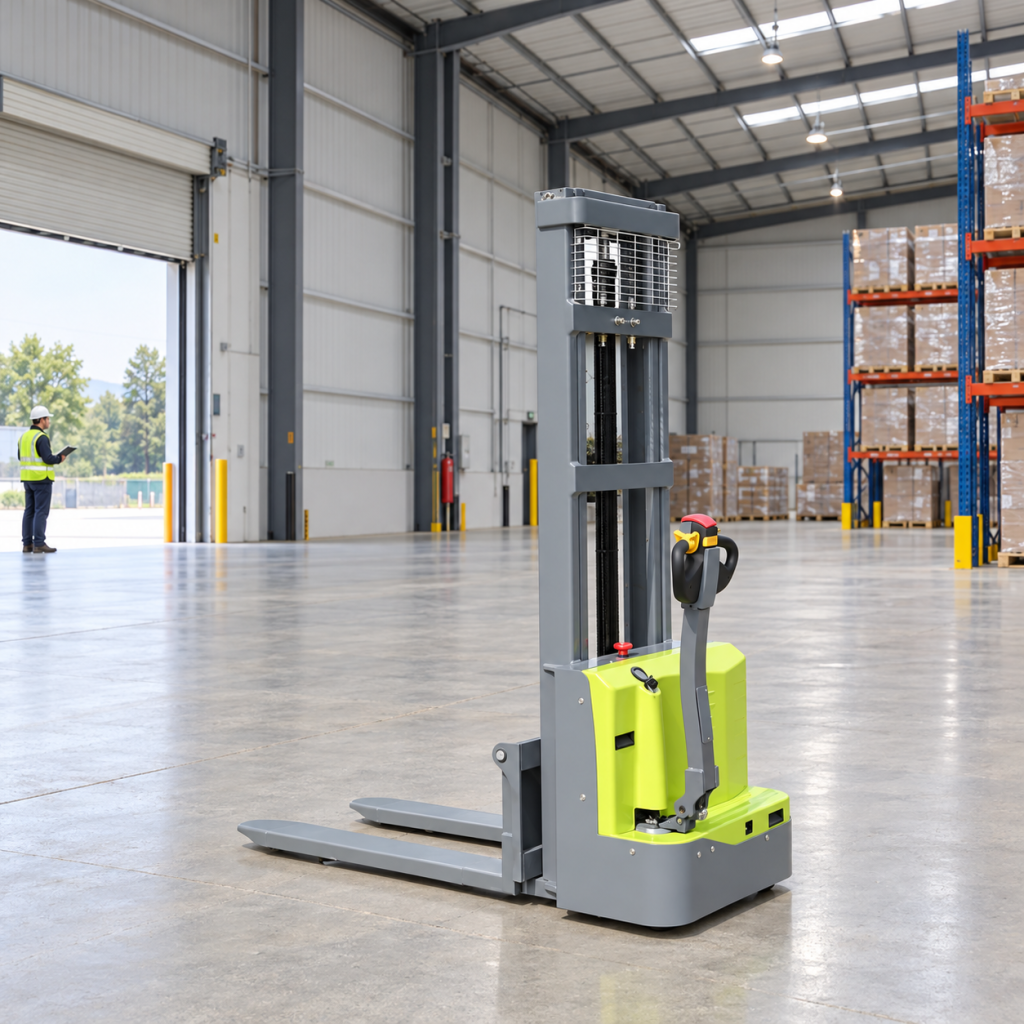
A stacker may reach the top rack yet be unable to pass the doorway leading to it. The mast's lowered height must be checked along the entire route.
Measure the lowest overhead opening on the real travel route and compare it with the proposed stacker's overall lowered height, including fitted guards and options. Then check the load and mast envelope during the intended lift. Maximum fork height alone cannot prove access or usable work space.

Illustrative scene based on a Jinge product photograph; no customer doorway or model clearance is measured by this image.
What is the difference between lowered mast height and lift height?
A brochure can show an impressive reach while the truck still cannot enter the warehouse. The two heights answer different questions.
Lowered mast height describes the truck's vertical envelope with the mast retracted for travel. Maximum fork height describes how high the forks can reach. Buyers need both values, plus the height of any load or guard that may determine whether a doorway or ceiling feature can be cleared.
A catalogue may lead with the highest lift because buyers need to reach a rack. That is only half of an access decision. The stacker has a mast that remains above the power unit even when the forks are low. Depending on mast design, the top of that structure may be the point that meets a doorway lintel, overhead service or low mezzanine. A guard, beacon or other fitted option can become the highest point. Request a dimensioned drawing of the exact quoted version, not a generic family picture.
The OSHA critical measurements guide distinguishes overall lowered height, overall raised height, free fork height and maximum fork height in its powered-truck examples. It warns against entering doorways or confined spaces without adequate clearance. The page is US forklift-focused guidance, so its examples are not dimensions for a GODWIN/Jinge stacker. Its measurement framework is useful: access and usable lift must be tested as separate questions.

Illustrative measurement scene; use the actual site opening and the manufacturer's drawing for a real clearance decision.
| Dimension | What it answers | Source to request |
|---|---|---|
| Overall lowered height | Can the retracted truck pass the opening? | Exact truck drawing or data plate |
| Overall raised height | What space is needed when the mast extends? | Mast specification for the quoted build |
| Free lift | How far can forks rise before the mast envelope changes? | Exact mast drawing and instructions |
| Maximum fork height | Can the forks reach the highest required placement? | Quoted mast specification and capacity data |
Do not subtract an assumed margin from a brochure number and call the route approved. The site must account for measurement uncertainty, floor changes and the operating procedure under its own rules. If the proposed drawing omits an accessory, ask the supplier to include it before accepting the figure.
Keep the two figures beside a sketch of the same truck, with the mast option and drawing revision written at the top. If one quotation names a different mast from the drawing, the buyer has no reliable access comparison yet. Resolve the mismatch before discussing how much height remains at the doorway.
Where should overhead restrictions be measured?
The main shutter may clear the stacker, but a later beam can end the route. Survey the whole journey.
Survey the complete route at the lowest real clearance, including door thresholds, mezzanine beams, sprinkler lines, signs and dock or trailer openings. Measure from the travel surface where the truck wheels actually run. Record the location and direction because a raised floor, ramp or joint can change the available height.
Start at the receiving point, then follow the truck to storage and back. A warehouse entrance may be tall while an internal fire door, cold-room opening or pipe crossing is lower. Note overhead features that project only over part of the aisle. A stacker may pass straight through a door but meet a beam when turning toward a rack. A plan-view route should be paired with a simple elevation sketch for these points.
Measure from the surface under the wheels to the underside of the lowest obstruction. If a door has a ramp or threshold, take readings on both sides and on the ramp crest. An opening measured from the surrounding floor could overstate clearance where the front and rear wheels are at different levels. Do not stand under a raised load or use the truck as a moving measuring device; perform the survey with suitable access equipment under site rules.

Illustrative route survey; the pictured obstruction is not a verified site measurement.
| Route point | Site evidence | Why it matters |
|---|---|---|
| Doorway or shutter | Clear opening height in normal operating position | Partially open doors may reduce the opening |
| Ramp or threshold | Height at approach, crest and exit | Floor profile changes effective clearance |
| Mezzanine or pipe crossing | Lowest fixed underside over the truck path | A local projection can be the limit |
| Dock or trailer | Door and internal roof along permitted route | Entry does not prove sufficient working room |
The HSE traffic-route guidance asks whether workplace routes are suitable for the vehicles using them. The OSHA physical-conditions page calls attention to overhead fixtures as a workplace condition. Both are jurisdiction-specific context; neither provides a universal clearance number for a stacker. The site team must supply actual geometry.
Record how each obstruction behaves during a normal shift. A shutter that is sometimes partly lowered, a movable sign or a temporary hanging cable creates a different route from the one photographed during a quiet survey. The site owner must either control that condition or mark the route unavailable when the required clearance cannot be maintained.
Can a stacker pass an opening while carrying a pallet?
An unloaded truck can pass the doorway while the regular pallet hits it. The load changes the vertical envelope.
Check the machine and load envelope in the permitted travel position, not the empty machine alone. A tall pallet, packaging overhang or raised forks may set the highest point. Confirm manufacturer-approved travel position and check the entire route, including turning areas, for sufficient space.
Measure representative loaded pallets, including the highest regular assembly and any unstable or unusual shape that needs separate handling. Record whether the goods extend above the mast while the forks are in the approved travel position. A supplier may show that an empty stacker fits a door, but this cannot answer whether a tall load can pass. Conversely, a load lower than the mast may leave the mast itself as the limit. The buyer needs both measurements.
Do not respond to a low door by lowering a load below the truck's permitted travel setting or by tilting a stack of goods to squeeze through. Follow the specific truck's manual and the site's load-handling rules. If a load cannot pass, consider an approved alternative route, different packaging, a different handling process or a different equipment configuration. Any change in load orientation should be checked for pallet entry, stability and capacity rather than made solely for height.
The OSHA load-handling guide reminds operators to consider door height and the vehicle's position when entering trailers and other constrained spaces. It is forklift-focused US guidance, not a prescription to use a stacker in every trailer. For a warehouse buyer, the key is that the load and vehicle travel together; neither can be assessed from an isolated catalogue dimension.
If the route includes a lift platform or mezzanine transfer, the platform's load rating, controls and operating rules need separate confirmation by the site owner. A suitable mast height does not approve the building structure or a route across a dockboard.
Why does free lift matter under a low ceiling?
A stacker may fit inside a room yet need to raise its mast into the ceiling to place a pallet.
Free lift is the fork movement available before the mast extends, as defined for the exact mast. It may permit some handling under restricted overhead space, but it cannot approve every low-ceiling lift. Compare fork position, load height and mast movement with the manufacturer's drawing and instructions.
Inside a room with a low ceiling, a stacker may enter with its mast retracted and still need to raise a pallet to a rack. The critical question becomes what moves upward first. Some mast arrangements allow the forks to rise a certain distance before the outer mast envelope increases; others behave differently. Do not infer free lift from the number of mast stages or a photograph. Ask for the precise value and how the fitted load backrest, carriage and forks affect the vertical envelope.
Plan the entire lift cycle: pick up at floor level, raise enough to clear the rack beam, place the pallet and withdraw the forks. The highest point may be the load top during placement or the mast top during extension. A rack that appears reachable by maximum fork-height data can still be unusable if there is not enough room for this sequence. The Crown ES 4000 walkie-stacker specification example lists free lift, collapsed mast and extended height separately for its own mast variants. It illustrates why the fields are distinct; its numbers do not apply to GODWIN/Jinge equipment.

Illustrative planning scene; no lift or ceiling-clearance test is being performed.
For high-rack work, capacity must also be checked at the required height and load centre. Ask for a rated-capacity chart covering the exact mast and load before signing off the rack task. Free lift and capacity are related to one task, but a mast's ability to move under a ceiling does not increase its approved load.
Which options can change a clearance decision?
The trial truck may clear a doorway, then a taller guard on the delivered build fails. Configuration must stay fixed.
Confirm the final mast, guard, backrest, forks and accessories before accepting a height figure. A quotation, demonstration machine and delivered truck may differ. Ask the supplier to identify the highest point in travel and during lifting for the final build, then recheck every low route point against that configuration.
Buyers often compare two mast choices by maximum lift. A taller mast can alter the retracted envelope, but the relationship is model-specific; it should be read from each option's drawing. A load backrest, protective screen or accessory at the mast top may create another high point. A different battery or wheel arrangement might alter floor-level geometry. Do not assume options are dimensionally neutral merely because they are listed on one product page.
Create a configuration checklist with the truck model, mast version, lift height, lowered height, free lift, backrest, forks and any mounted attachments. Attach the exact dated drawing used for approval. When the demonstration unit arrives, compare visible parts and identification with that list. If it differs, the trial can still provide limited information, but it cannot verify the quoted build without an explicit explanation of the difference.
The same check belongs at delivery. A drawing marked for the quoted mast is only useful if the serial-numbered machine carries that mast and the listed options. Photograph the highest fitted component from the side and compare it with the accepted drawing before treating the earlier doorway trial as transferable.
| Configuration item | Evidence to keep | Recheck trigger |
|---|---|---|
| Mast version | Drawing with lowered and raised heights | Any mast substitution |
| Guard or backrest | Fitted height and mounting detail | Option added or removed |
| Fork and load package | Travel envelope with real pallet | New or taller pallet |
| Wheels or route surface | Truck geometry and actual floor profile | Floor repair, ramp or wheel change |
The GODWIN electric stacker category presents different equipment designs, but a category page cannot approve a specific low doorway. Ask for the final configuration details through the GODWIN contact page. This article intentionally publishes no named GODWIN/Jinge lowered-height or free-lift value because the current model-level document has not been verified here.
What should a doorway trial and RFQ record?
A quick empty pass looks convincing, but it leaves the loaded lift and return route untested. Record both conditions.
Send a route map with measured overhead points, floor changes, load heights and the lift task. Request a drawing for the exact truck and mast. Before a controlled trial, verify truck and load against the documents; record entry, turn, lift and exit without using contact as a clearance test.
A useful RFQ names each restriction point: D1 door, B1 beam, R1 ramp crest, and so on. For each, record measured clearance, measuring point, direction of travel and whether the truck will be empty or loaded. Add the highest rack placement and the pallet height. Photographs with a tape or straightedge help explain the geometry, but the supplier still needs written measurements because perspective can mislead. Ask the supplier to return a model-level height table that covers both travel and working states.
The trial should begin with a stationary review. Confirm capacity and route suitability; remove any damaged or obstructed area from the test until the site team resolves it. A trained, authorised operator should follow the actual truck's manual while observers remain clear. An empty pass through the door may be a first step, but the representative loaded task and any permitted lift under the ceiling require their own check. Stop before contact with a fixed obstruction; a scrape is evidence of a failed clearance plan, not a measurement method.

Illustrative preparation scene; no real customer access test or measured clearance is represented.
After the trial, record the truck identity, mast version, load, route and all restrictions that were actually tested. Note any condition that remained unverified, such as a taller seasonal load or a door that was fully open only on demonstration day. Store the result with the accepted quotation and building plan. If the site later lowers a shutter, adds pipework or changes racks, the original access approval should be revisited rather than assumed to cover the new geometry.
Conclusion
Lowered mast height is an access value; maximum lift height is a working value. Both must match the same truck and real warehouse route. Measure low points from the actual travel surface, include the load and final options, and verify the full task in a controlled trial. Keep the drawings and measurements so future changes trigger a fresh check.


 English
  Español
  Français
  العربية