 Skip to content
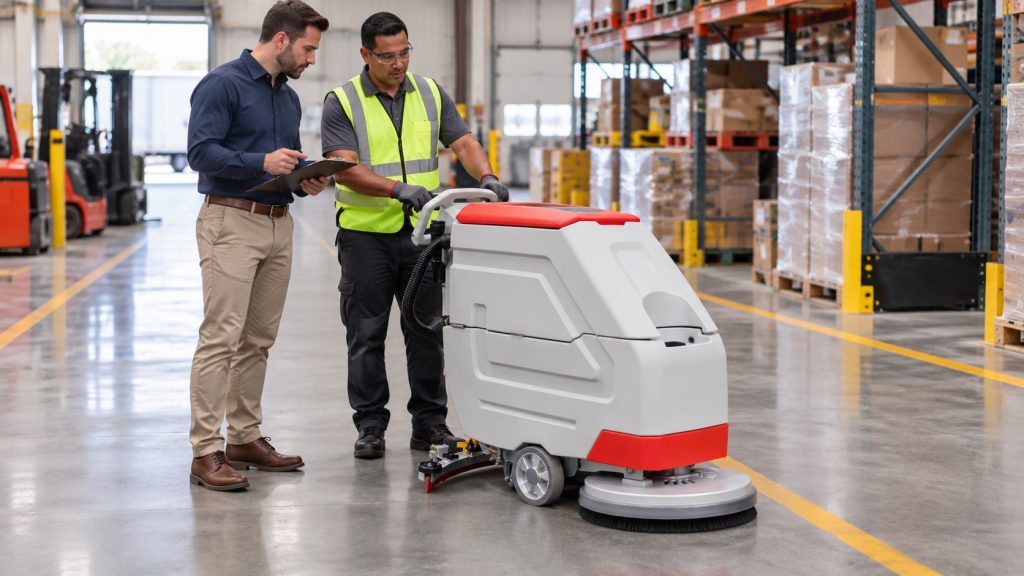
I can watch a scrubber cross a clean showroom floor, but that does not tell me whether it will finish my site's work.
Plan a floor scrubber trial around the real route, typical soil, approved floor-care method, trained operator, and agreed acceptance criteria. Record the tested machine configuration, access, elapsed time, stops, floor result, and residual water. State what the short trial cannot prove about full-shift operation or long-term service.
The site survey defines the job before the visit. This guide turns a demonstration into evidence the buyer and supplier can review together.
What Question Should the Trial Answer?
I need a clear decision question or the demonstration will become a tour of features I may never use.
Write the buying decision as a testable question: can this exact configuration clean the required zones, achieve the agreed floor result, and fit the available work window? Add specific questions about turns, edge work, refill, disposal, operator handling, or charging where they could change the selection.

Begin with the site's constraint rather than the supplier's strongest feature. A warehouse may need to clean while traffic continues in adjacent aisles. A retail floor may require low residual moisture before reopening. A production area may have stubborn soil but a short access window. Each creates a different reason to accept or reject a machine. Write these reasons down before the trial so a visually attractive pass does not replace the actual requirement.
Select one main question for each test. “Does the ride-on fit the narrow turn?” can be observed directly. “Can the crew finish all planned zones before the next shift?” needs a representative timed route and a realistic allowance for all remaining zones. “Will this battery last all day?” generally cannot be proved by a ten-minute demonstration. The answer should remain conditional until the battery and charger are identified and the complete shift is tested or otherwise supported.
List the exact unit, model and configuration on the trial sheet. Record brush or pad, squeegee, battery, charger, and any option that differs from the quoted product. A test of a specially equipped demonstrator does not automatically approve a different delivery. Ask the supplier to explain any substitution in writing.
| Decision question | Observable measure | Limit of a short test |
|---|---|---|
| Can it reach the route? | Door, aisle, turn and return observed | Other seasonal obstacles may differ |
| Does it clean the soil? | Before/after floor record | Future soils may differ |
| Does it recover water? | Immediate and follow-up moisture check | Blade wear over time is untested |
| Does it fit the window? | Timed representative route | Full-shift stops may differ |
| Can operators handle it? | Trained operator notes | Training and fatigue need longer review |
Agree who will judge each item. The floor owner, cleaning operator, safety lead, and buyer may notice different issues; their roles should be clear before the machine moves.
How Should the Test Route Be Chosen?
I can make almost any machine look productive on a long empty aisle, so I need a route that resembles the daily job.
Choose a route containing typical straight travel, a normal turn, the most restrictive access point, representative edge work, and the soil that matters to the buyer. Trace movement from storage through refill and disposal as well. Measure cleanable area and document traffic conditions.

Walk the route before the demonstration and mark every segment on a simple sketch. Include door widths, guard rails, racks, parked equipment, and a turn where the machine must change direction. Identify whether these conditions are normal, temporary, or unusually clear today. If the trial is held outside normal operating hours, note the missing traffic and plan a safe way to assess its effect later.
Do not use gross building area to estimate test coverage. Fixed racks, stock, equipment, and no-access rooms are not part of the machine-cleanable path. Measure or reasonably map the area actually contacted by the cleaning head. If a candidate cannot enter a required zone, record the alternate method and its time; do not silently omit the zone from the comparison.
Select a meaningful soil condition. If the typical problem is tire marks, a dust-free section will not answer it. If the site has multiple floor finishes, test each important finish or restrict the conclusion to the one tested. Remove hazardous or machine-inappropriate debris under site procedures before the demonstration. The pre-sweeping guide helps determine ordinary debris preparation.
Photograph the route and mark start and end points. Use the same route for competing models where feasible. If one candidate is smaller and can reach additional side rooms, compare the whole cleaning plan rather than only the shared central aisle.
Which Setup Must Be Held Constant?
I cannot attribute a better finish to the machine if the second test uses another pad, cleaner, or soil condition without recording it.
Keep the floor standard, route, soil, operator training, and approved cleaning method comparable. Record machine-specific consumables, solution, water setting, battery state, and any necessary differences. Do not force identical settings where the delivered manuals require different procedures; explain the difference instead.

Obtain the floor owner's instructions first. The surface may require particular chemistry, dilution, contact material, or a test patch. The demonstration must stay within those instructions and the machine's delivered manual. An aggressive pad can make one pass appear effective while damaging a finish, so soil removal alone is not the acceptance test.
Record the machine condition before starting. Note whether tanks are filled, recovery tank is empty, squeegee is clean, brushes or pads are serviceable, and the battery is at a documented state. A poorly prepared machine may show a defect unrelated to its model, but an undocumented adjustment can also hide a repeatability problem. Let trained personnel make permitted adjustments and write down what changed.
Use comparable operators. If a supplier specialist runs one candidate and an untrained site employee runs the other, the time result is confounded. An appropriate arrangement is to have each trained operator explain the controls, then let the same site operator try both under supervision where safe. Note any practice time. Observe how the intended team handles the machine after instruction.
If the two machines need different brushes, pads, or water settings to achieve the same floor standard, that is useful information. Record it as part of the complete process, including consumable and care implications. A comparison does not need artificial sameness; it needs transparent conditions and the same required outcome.
What Should Be Timed and Photographed?
I need more than a stopwatch on the straight pass because the buying decision includes all the stops and the finished floor.
Time preparation, active passes, turns, extra passes, travel, refill, recovery-water disposal, interruptions, and end-of-trial care. Photograph the floor before and after under similar lighting, including edges and any water trail. Capture the model identification and trial conditions without claiming the images represent a long-term customer result.

Start the clock when the operator begins the agreed preparation, not only when the brush starts. If the site's normal procedure includes removing loose packaging, placing signs, and filling a tank, log those tasks. Mark the time when the machine starts cleaning, reaches each turn, pauses, refills, and completes the route. Finish after the agreed inspection and equipment care. This produces a complete schedule estimate.
The before photograph should show typical soil, floor finish, and the area to be cleaned. After photographs should cover the same views at comparable light and distance. Inspect immediately for standing water and again after the site's specified wait if relevant. A single image can hide a thin water trail or an untreated edge, so use short notes alongside photos.
Record whether an extra pass was needed and why. If it was for adhered soil, the process may need different approved chemistry or dwell time. If it was for residual water, examine squeegee condition and setup through the manual's safe checks. The water-recovery guide helps classify that symptom, but the trial record should state what was actually observed.
| Record | Minimum detail | Why it matters |
|---|---|---|
| Machine | Model, revision, battery and cleaning setup | Links result to exact configuration |
| Route | Sketch, distance or cleanable area, constraints | Makes time interpretable |
| Timing | Start, stops, finish and care | Captures total process |
| Floor | Before/after, edge and moisture notes | Tests the required outcome |
| Conditions | Soil, traffic, operator and changes | Defines what the result can support |
Store original photos and the completed log with the quotation. Avoid editing the photos in a way that obscures soil or water.
How Should Operators and Safety Staff Participate?
I want the people who will operate and share the route to identify problems while a supplier can still address them.
Have a trained operator perform the normal route under the site's traffic and floor-safety controls, while a buyer records results and the site safety lead oversees shared areas. Stop for unexpected spills, damaged flooring, unsafe interaction, or machine faults. Operator feedback should name specific handling issues.
Explain the test to adjacent teams. If forklifts or pedestrians normally use the route, arrange an approved window or separation so the trial does not create an unsafe conflict. The safety lead should decide signs, barriers, and the point at which the floor is ready for other users. A trial should not trade safety for a flattering time.
Ask the intended operator to evaluate controls, visibility, turning, stopping, refill, wastewater handling, and cleaning after use. “Easy to drive” is less useful than “requires two reverse maneuvers at aisle three” or “recovery hose is difficult to inspect at the approved disposal point.” Specific observations can be checked or incorporated into training and equipment selection.
The supplier should identify which tasks an operator may perform and which require qualified service. A demonstration may reveal a blocked visible filter or dirty squeegee; routine checks can be performed only as the delivered manual permits. Electrical faults, unexplained leaks, or repeated shutdowns should be escalated rather than repaired ad hoc during a buyer trial.
If the site uses several shifts, include a representative operator from each if possible. A one-person demonstration cannot establish routine fleet adoption. Record training needs and any limitations that would affect the purchase, such as storage or charging access.
How Do Buyers Turn Results Into Acceptance?
I need the record to say whether the machine met the agreed requirement and what remains unproved.
Compare the observed result with the acceptance criteria agreed before the test. Mark each item pass, fail, or untested, and record corrective actions or a repeat trial where appropriate. Tie the final purchase to the exact tested or equivalently documented configuration, plus clear delivery and handover terms.
Review the route sketch, timing log, floor images, operator notes, and configuration sheet together. A pass should correspond to the buyer's requirement, not a general impression. If cleaning quality fails, decide whether the cause was method, consumable, machine condition, or model fit. An authorized adjustment and repeat can be fair; an undocumented switch cannot.
List the limits of the trial. A short test may show access and immediate water recovery, but not battery duration across several shifts, long-term part wear, seasonal soil, or service response in another country. Those points may need written manufacturer documentation, a longer test, a supplier commitment, or a condition in the order. Keep unknowns visible.
| Acceptance item | Result | Action |
|---|---|---|
| Required access | Pass / fail / untested | Retest exact route if unclear |
| Floor result | Pass / fail / untested | Identify method or machine cause |
| Water recovery | Pass / fail / untested | Check setup and repeat safely |
| Total schedule | Pass / fail / untested | Model full shift with measured stops |
| Supply match | Pass / fail / untested | Align quote with tested package |
Send the record with the quotation comparison. Confirm model, battery, charger, brushes or pads, manuals, warranty, and handover scope in the purchase documents. A site trial is most valuable when the delivered machine can be checked against what was actually tested.
Agree in advance who signs each part of the result: operations for route and schedule, the floor owner for the surface outcome, and procurement for the ordered configuration. Photograph the tested machine's identification and consumable setup with the supplier present. If the final quote substitutes a different battery, brush, or squeegee, identify the change explicitly and decide whether it requires another targeted test. Store the trial log with the handover documents for later reference.
Conclusion
Test the real route against agreed outcomes, record the complete process, and keep untested claims conditional.


 English
  Español
  Français
  العربية