 Skip to content
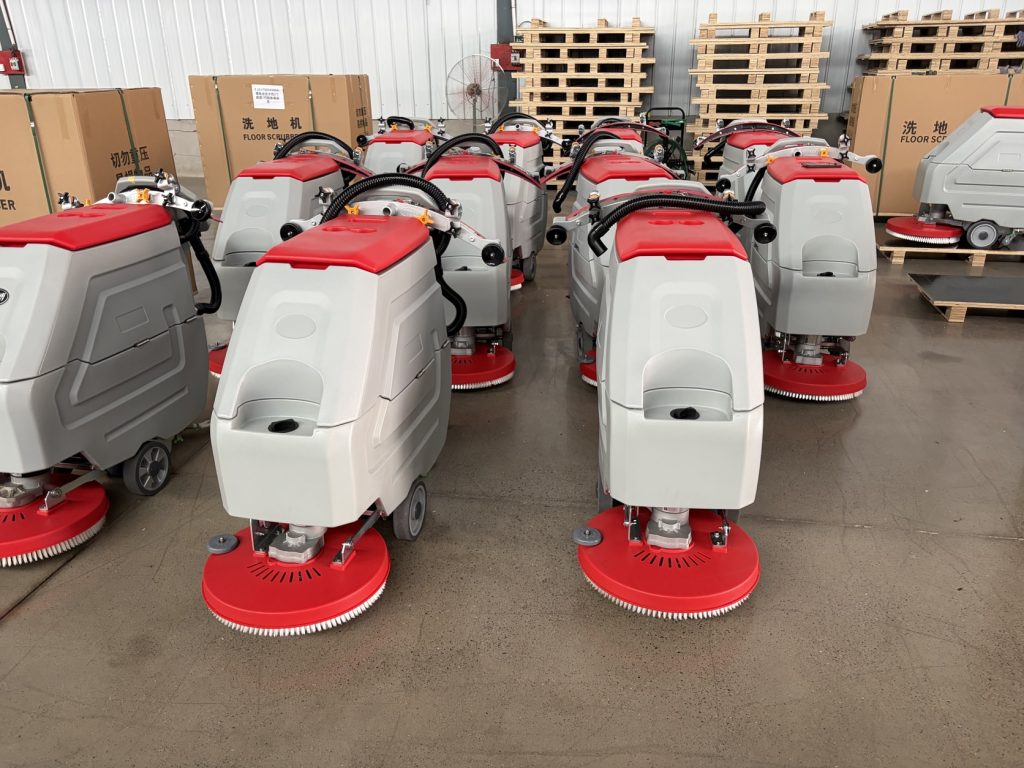
I can see two similar walk-behind scrubbers in a catalogue, but small differences in working width, squeegee, and drive affect my route.
The current GODWIN catalogue lists GDW1 at 500 mm working width with 55 L solution and 65 L recovery tanks, and GDW2Z at 530 mm with 55 L and 60 L tanks. GDW2Z lists a 300 W drive motor. These data screen candidates; the exact configuration and site trial decide fit.
This comparison uses the current formal catalogue for each named model. It does not carry older GDW2 figures over to GDW2Z or treat catalogue productivity as a guaranteed result.
Which Current Specifications Actually Differ?
I want one reliable comparison table before a supplier recommends a machine on the basis of an old web page.
GDW2Z has a 30 mm wider catalogue cleaning path, while GDW1 has a 30 mm wider catalogue squeegee and a 5 L larger recovery tank. Both list 55 L solution capacity. These are exact current-catalogue differences, but none independently proves faster cleaning or better water pickup at a site.

The 2026 formal GODWIN floor-scrubber catalogue identifies GDW1 and GDW2Z as current products. It prints the working width, squeegee width, tank capacities, and other model fields on its comparison page. Use the same source revision for both machines when preparing an RFQ. A buyer who mixes a recent GDW2Z row with a historical GDW1 row can accidentally manufacture a difference that no current offer contains.
Working width is the nominal path of the cleaning head. A wider path may reduce the number of straight passes on a large unobstructed lane, but usable overlap, turns, edges, and soil-driven repeat passes change the result. Squeegee width matters when checking access and water recovery geometry. It is not a quality score: blade condition, floor joints, machine setup, and operation can matter more than a small width difference.
Tank capacities need context. The same 55 L solution capacity appears for both models. GDW1 lists 65 L recovery and GDW2Z 60 L. That does not imply one machine can complete a certain number of hours before emptying; water setting, soil, fill practice, site rules, and recovered volume vary. The operator should still empty at the approved location and follow the delivered manual.
| Current catalogue field | GDW1 | GDW2Z | Buyer interpretation |
|---|---|---|---|
| Working width | 500 mm | 530 mm | Test route time and overlap |
| Squeegee width | 830 mm | 800 mm | Verify working access and recovery |
| Solution tank | 55 L | 55 L | Same printed nominal capacity |
| Recovery tank | 65 L | 60 L | Observe actual stop pattern |
| Drive motor power | Not specified, printed “/” | 300 W | Confirm exact delivered drive behavior |
The slash in GDW1's drive-motor field is not evidence that every GDW1 has no powered drive. Ask the supplier to state the operating configuration in the actual offer.
How Does Drive Behavior Change the Operator's Work?
I do not want to infer how the machine feels to operate from a motor wattage alone.
GDW2Z has a listed drive motor; GDW1's drive-motor field is unspecified in the current catalogue. Ask the supplier to demonstrate the exact units on the planned route. Compare walking effort, control, starts, turns, slopes within approved limits, and end-of-shift handling with trained operators.

A drive motor can change how propulsion is supplied, but rated power does not by itself predict comfortable handling or route productivity. Control sensitivity, steering geometry, surface friction, tank load, and operator training all matter. Watch a start, stop, turn, and reverse maneuver on a representative floor. If the route includes a ramp, use the delivered manual and competent site review to decide whether the machine and operator can use it; do not infer an approved slope from motor power.
The operator should also assess the posture and walking path. A machine that turns smoothly in a straight warehouse aisle can be awkward at a small closet or between fixed shelves. Check that the operator has enough room behind or beside the handle, can see nearby people and obstacles, and can reach controls without awkward movement. Have the supplier show the normal operating sequence and approved pre-use checks.
Avoid describing GDW1 as a guaranteed manual-push model merely because an older manual or website calls it that. The current formal catalogue's slash field lacks the detail required to make that claim for every delivery. Request a video or demonstration of the offered revision, and put the propulsion and control arrangement in the purchase documents.
If the site uses more than one operator, train and observe representative users. A purchase should work for the routine team, not only the supplier demonstrator. Record handling differences alongside actual cleaning result and total time. The walk-behind versus ride-on guide covers the broader operation-form decision.
Which Dimensions Matter Along the Route?
I can lose the apparent benefit of a 30 mm wider cleaning path if the machine cannot turn or pass through a critical opening.
Measure the narrowest door, aisle, storage bay, lift, and turning area, then confirm full machine clearance with the installed squeegee and ordered options. The catalogue's overall dimension sequence is a screening reference; its axis meaning, operating state, and tolerances need confirmation before approving a tight route.

The current catalogue prints GDW1 overall dimensions as 1260 × 830 × 1120 mm and GDW2Z as 1250 × 560 × 1060 mm. Those printed sequences should be retained as data, but the internal knowledge record flags that the exact axis definitions, tolerances, and operating or transport state are not published. A buyer should not assume a particular axis is the maximum width or that the squeegee position is included. Ask the supplier to provide a dimensioned drawing or inspect the physical machines.
Mark the complete route. Include the machine's path from storage to cleaning, the return to a water point, and any lift or ramp. Obstacles may appear only during production hours. Measure clear space with guards, pallet loads, and open doors in their normal position. A machine that passes a doorway while traveling straight may not turn immediately afterward.
Observe edge work. The cleaning head and squeegee are different widths and positions, and walls or racks may prevent a full close pass. Count the manual edge-cleaning or smaller-machine work required for each candidate. The goal is a complete site process, not merely the fastest central aisle.
The site-survey article offers a collection form, and the general selection guide explains how to bring route, soil, and schedule together.
What Should a Fair GDW1–GDW2Z Trial Record?
I prefer a short, repeatable site test to a claim that one nominal width automatically wins.
Test GDW1 and GDW2Z on the same cleanable route with the same floor standard, typical soil, operator conditions, and approved consumables. Record access, pass count, water pickup, stops, maneuvering, and total elapsed time. State any configuration difference that prevents a direct like-for-like comparison.
Choose a route with a straight section, at least one normal turn, a narrow point, and the typical soil. A pristine showroom pass will not test the reason you are buying the machine. Record the floor condition and what was done before each test, including pre-sweeping or spot treatment. Do not deliberately expose either machine to material the manual or site rules prohibit.
Use trained operators and a safe cleaning window. Time preparation, active cleaning, extra passes, refill or emptying, travel, and end-of-test care separately. Compare the completed floor in similar lighting. Water trails should be recorded and investigated, not hidden by a photograph taken from a favorable angle. If a setup issue affects one machine, correct it through an authorized procedure and repeat that portion with a note.
Battery and charger configurations must also be noted. The current catalogue does not establish a universal delivered chemistry or charge plan for either model. A demonstration with one battery package cannot guarantee a different ordered package will complete the same full shift. Our battery-schedule guide identifies the questions to ask.
| Trial observation | GDW1 record | GDW2Z record |
|---|---|---|
| Exact unit and configuration | Model, revision, battery, brush | Model, revision, battery, brush |
| Access and turns | Pass/fail and notes | Pass/fail and notes |
| Cleaning result | Photos and extra passes | Photos and extra passes |
| Water recovery | Residual trail and conditions | Residual trail and conditions |
| Complete route time | Preparation through care | Preparation through care |
A trial result belongs to the recorded route and conditions. It is evidence for this purchase, not a public productivity specification for all users.
How Should Buyers Resolve Old GDW2 Information?
I see GDW2 and GDW2Z used close together online, and I do not want an old name to determine my order.
Treat GDW2 and GDW2Z as distinct labels until the supplier confirms a documented relationship for the offered machine. Do not move GDW2 page specifications, battery assumptions, pictures, or spare-part references onto GDW2Z. Identify the exact model, revision, nameplate, and included parts in the quotation.
An older GODWIN website page may still present a GDW2 walk-behind machine. The formal current catalogue includes GDW2Z. Similar appearance and the shared “GDW2” stem are not proof that the models are technically identical or that every replacement part fits both. Product pages can also remain online after a catalogue changes. Use the current signed offer and delivered labels to settle the identity for a particular order.
Ask for a current product sheet naming GDW2Z and showing the proposed configuration. If a salesperson cites a historical GDW2 feature, request written confirmation that it applies to this GDW2Z revision. The same rule applies to accessory photos. A photograph may show a charger, brush, or pad holder that is not included in the quote.
For after-sales planning, retain the serial number and actual delivered part identifiers. Do not create a parts list by matching photographs across model names. The exact machine manual, approved parts data, and supplier confirmation control replacement selection. The spare-parts planning guide explains the evidence a distributor should keep.
This distinction also protects content quality: a comparison table should state its source and date, and clearly mark a missing field instead of filling it from a neighboring model. If the offered model differs from the catalogue, pause and obtain the revised technical information before deciding.
Which Model Should Reach the Final Quote?
I would shortlist one or both models only after the route, operator, and cleaning result have been observed.
Advance the model that meets access, floor result, operator handling, schedule, and supply requirements under the buyer's documented conditions. If both work, compare the exact battery, charger, consumables, documents, service scope, and complete price. If evidence is missing, keep the decision conditional.
Do not convert the GDW2Z's wider working path into a guaranteed labor saving. Do not turn GDW1's larger recovery tank into a promised longer shift. These are catalogue attributes that require a site process around them. A narrow route can favor one configuration even when a nominal width suggests the other. Two buyers with different floors, access, and operating windows can reasonably make different choices.
When requesting a quote, include the site survey, the trial record, and an itemized configuration. Ask the supplier to state current model name, quantity, battery and charger identity, cleaning contact materials, manuals, included accessories, warranty terms, delivery basis, and any options. The quotation-comparison guide supplies a review framework.
| Final decision gate | Evidence needed | Result if missing |
|---|---|---|
| Model identity | Current product sheet and quote | Hold technical comparison |
| Route fit | Measurements and observed trial | Retest access |
| Cleaning standard | Comparable floor record | Refine method and retest |
| Shift plan | Timed route and battery package | Keep runtime conditional |
| Support | Manuals, parts path and warranty scope | Request written clarification |
If GODWIN reviews the request remotely, send floor and soil photographs plus the critical route dimensions. That gives the team a basis for proposing a testable configuration without pretending an online comparison can replace the site check.
If the two candidates both meet the cleaning standard, compare the completed route rather than declaring a winner from one catalogue field. Include operator effort, the number of stops, safe access, and any manual work left at edges. Mark results that depend on a particular brush, battery, or trial operator. Ask for the same package in the final offer or repeat the relevant test when the quoted configuration changes. Retain both records for future route changes.
Conclusion
Use current GDW1 and GDW2Z data to shortlist, then let the exact configuration and representative route trial decide.


 English
  Español
  Français
  العربية