 Skip to content
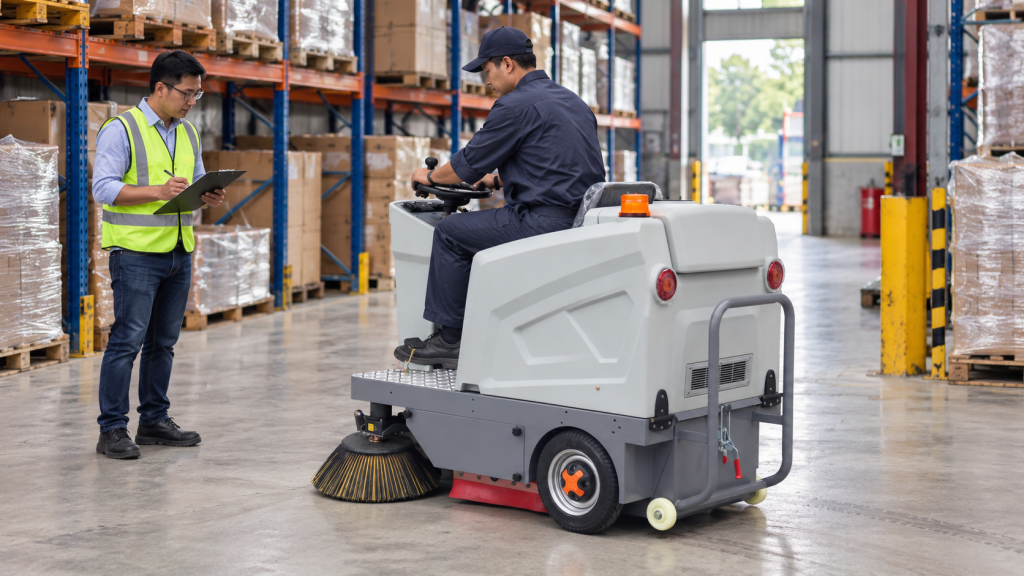
A sweeper that looks impressive on an empty showroom floor may miss debris along a rack, throw dust at a turn, or lose its time advantage when the operator has to empty the hopper far from the route. A site trial should answer whether the exact proposed configuration can clean a real route to the buyer's standard within the available work window.
Before the trial, define the route, normal debris, safety controls, operator, machine setup, and acceptance criteria. During it, record pickup, dust, edge and turn results, elapsed time, stops, hopper emptying, operator feedback, and the condition after cleaning. Mark full-shift runtime or long-term wear untested unless the test actually supports them.
The industrial sweeper buying checklist helps shortlist equipment. This guide covers the evidence to collect when a shortlisted unit comes to the site.
What Decision Should the Trial Answer?
Turn the purchase requirement into specific pass, fail or untested questions. Can the sweeper enter every required zone? Does it collect the normal material without an unacceptable visible dust plume? Can the intended operator complete the route and dispose of the load safely in the available window? Write the criteria before the supplier begins; otherwise the demonstration may focus on the machine's most flattering feature.

Bring operations, the intended operator, procurement, and the site safety lead into the planning. Each has a different decision: floor result, handling, supply match, and safe interaction with people and traffic. Assign a person to record timestamps and photographs. Agree which areas may be entered, how forklifts or pedestrians will be separated, and where the machine may be emptied or charged.
Photograph or record the model plate and supplied package. Note battery and charger, brush arrangement, filter, hopper, and accessories. A specially equipped demonstrator cannot prove the performance of a different quoted package. If the supplier changes a brush, speed or filter setting during the trial, log the change and the reason.
| Decision question | Trial observation | Short-trial limitation |
|---|---|---|
| Can it reach the job? | Doors, turns, ramps, edges and storage | Temporary obstacles may differ |
| Does it clean? | Debris and dust before/after on the same views | Seasonal debris remains untested |
| Does it fit the window? | Complete route and stop times | Longer shifts may differ |
| Can it be operated safely? | Trained operator and approved traffic plan | Repeated-use fatigue untested |
How Should the Test Route Be Selected?
Choose a representative route, not merely the widest and cleanest aisle. Include normal straight travel, a restrictive passage, an ordinary turn, edge cleaning, the site's typical debris, and the path to the disposal point. Mark start and finish. Map the area the brushes can actually reach rather than using the gross building area.

Walk the route first and record door and aisle widths, low clearance, slopes or rough patches, floor joints, parked equipment, and pedestrian or vehicle crossings. Identify whether today is normal or unusually clear. If the candidate cannot reach a required corner, record the alternative method and its time instead of removing that corner from the comparison.
Select ordinary material from the site's work cycle. Light packaging debris, dry leaves, sand and fine process dust are different tasks. The trial should avoid machine-inappropriate or hazardous material unless the site safety team has approved the method and the delivered documentation confirms suitability. Do not create a dangerous test pile to make the demonstration look demanding.
If two models are compared, use the same route and floor standard when possible. Make conditions transparent: weather, ventilation, traffic, debris amount and floor moisture may change. A different brush or permitted setting can be used for each machine, but record it as part of the complete configuration that would be purchased.
Which Setup and Safety Details Must Be Logged?
Record machine condition and the site's controls before starting the clock. Note battery state, brush and skirt condition, filter seating, hopper condition, operator training, normal speed, traffic barriers, and the approved disposal route. Let trained personnel make only the checks and adjustments allowed by the model's manual.

Inspect for obvious damage or leaks, check whether the proposed unit matches the quotation, and photograph its configuration. A dirty filter can cause a poor result unrelated to the model, while an undocumented filter swap can hide a repeatability problem. Log every change and, where it materially affects the outcome, repeat the relevant segment.
Coordinate with the site's traffic manager. Use the normal safe speed and keep observers out of the machine path. Stop if dust, debris, visibility or interaction with other traffic becomes unsafe. For materials that may be combustible, toxic or subject to a specific exposure control, a general commercial sweeper trial is not an adequate safety determination. OSHA's combustible dust guidance is one reason to identify the material before moving a machine through it.
| Setup item | Minimum record | Why it matters |
|---|---|---|
| Exact unit | Model/serial, battery, charger, brushes, filter | Connects result to quoted delivery |
| Condition | Brush, skirt, filter and hopper state | Distinguishes model fit from maintenance |
| Operator | Name/role, training and practice | Reduces comparison bias |
| Site controls | Traffic separation, approved material and disposal | Keeps the test within site rules |
What Should Observers Measure During the Pass?
Time the complete process and record the floor result at fixed points. Start with preparation; log active sweeping, turns, reverse maneuvers, travel, interruptions, extra passes, hopper emptying and end-of-use care. Finish after inspection. Record area or route length with the elapsed time. A catalogue m²/h figure cannot substitute for these observations.

Take before and after images of the same floor sections under comparable lighting. Inspect an edge, an open aisle, a turn and any usual debris concentration. Record missed material, pushed piles, track marks and extra passes. Look for a visible plume to the side or rear of the machine, especially at turns, and for dust settling on adjacent surfaces. Visual observations do not measure particle concentration, so use an approved measurement method if the site's acceptance requirement is quantitative.
Stopwatch entries should be specific: “hopper emptying, 4 minutes at west disposal point” is useful; “some downtime” is not. Note whether the hopper was close to full and how much dust escaped when it was emptied. Record filter cleaning or maintenance interruptions, but do not perform unapproved service during the demonstration. If a candidate requires a second pass to meet the floor standard, include that time.
Ask the intended operator to explain handling observations: visibility, steering, braking, turning, controls, access to the hopper, and whether the machine fits the storage or charging location. “Easy to operate” is too vague; “needs two reverse moves at rack three” can inform the buying decision. When appropriate, let another trained operator repeat the difficult segment to distinguish unfamiliarity from a genuine access issue.
| Trial record | Capture | Compare against |
|---|---|---|
| Pickup | Same-view before/after, edge and trail | Agreed floor standard |
| Dust | Side/rear observation, settling, disposal | Site's accepted visible result |
| Time | Preparation through inspection | Available work window |
| Stops | Turn, traffic, filter and hopper events | Whole-route productivity |
| Operator | Specific handling and visibility notes | Normal staffing and training |
How Do You Interpret Productivity and Runtime Honestly?
Use the measured cleanable route and elapsed process time, then state the limits of extrapolation. The route's apparent rate can help compare alternatives on the same site. It does not prove daily area capacity if other zones have different debris, access or traffic. The GODWIN catalogue lists working widths, capacities and time ranges, but it does not provide a common field-test method for ranking all models on this site.
If the demonstration lasts twenty minutes, it cannot establish a battery's full-shift duration. Record the battery and charger that would be delivered, state the starting and ending charge indications, and request a longer test or applicable documentation if runtime is decisive. Charging and storage conditions also need a site check. Do not infer that a larger optional battery is included because it appears in catalogue material.
Calculate the whole-route schedule with explicit allowances for zones outside the trial, travel to disposal, traffic waits, and likely debris-load variation. Use an observed central case and a slower case. If the site requires continuous multi-shift use, test or document that use separately. A fast straight pass on an open aisle cannot justify a claim that the full site will be completed at the same rate.
How Should the Trial Become a Buying Decision?
Compare each observed result with the criteria agreed at the beginning. Mark access, pickup, dust, disposal, schedule and operator handling as pass, fail or untested. Attach route sketch, timestamps, original photos, machine identification, setup changes and observers' names. Explain any retest and keep both results.

A failed result may be caused by unsuitable equipment, an incorrect consumable, poor machine condition, or a site procedure that needs revision. Identify the cause before deciding whether a safe adjustment and repeat test is worthwhile. Do not remove an inconvenient observation from the record. A pass on pickup with an unacceptable dust release or unsafe disposal route is not a complete pass for the site.
Confirm the final quotation against the tested model, battery, charger, brush/filter set, accessories, manuals, training, warranty, parts route and delivery scope. Where the quote differs, ask the supplier to document the effect or repeat the affected test. Operations should approve floor result and schedule, safety should approve the operating method, and procurement should approve the delivered configuration.
Keep the trial log with the purchase and handover documents. On delivery, use it to check the supplied machine and compare actual first-week performance with the assumptions. This turns the demonstration into a useful reference for training, maintenance and later fleet decisions.
Conclusion
A useful floor sweeper trial tests the real route, real debris and complete process against written acceptance criteria. Record what was observed, what failed and what remains untested before committing to the quoted configuration.


 English
  Español
  Français
  العربية