 Skip to content
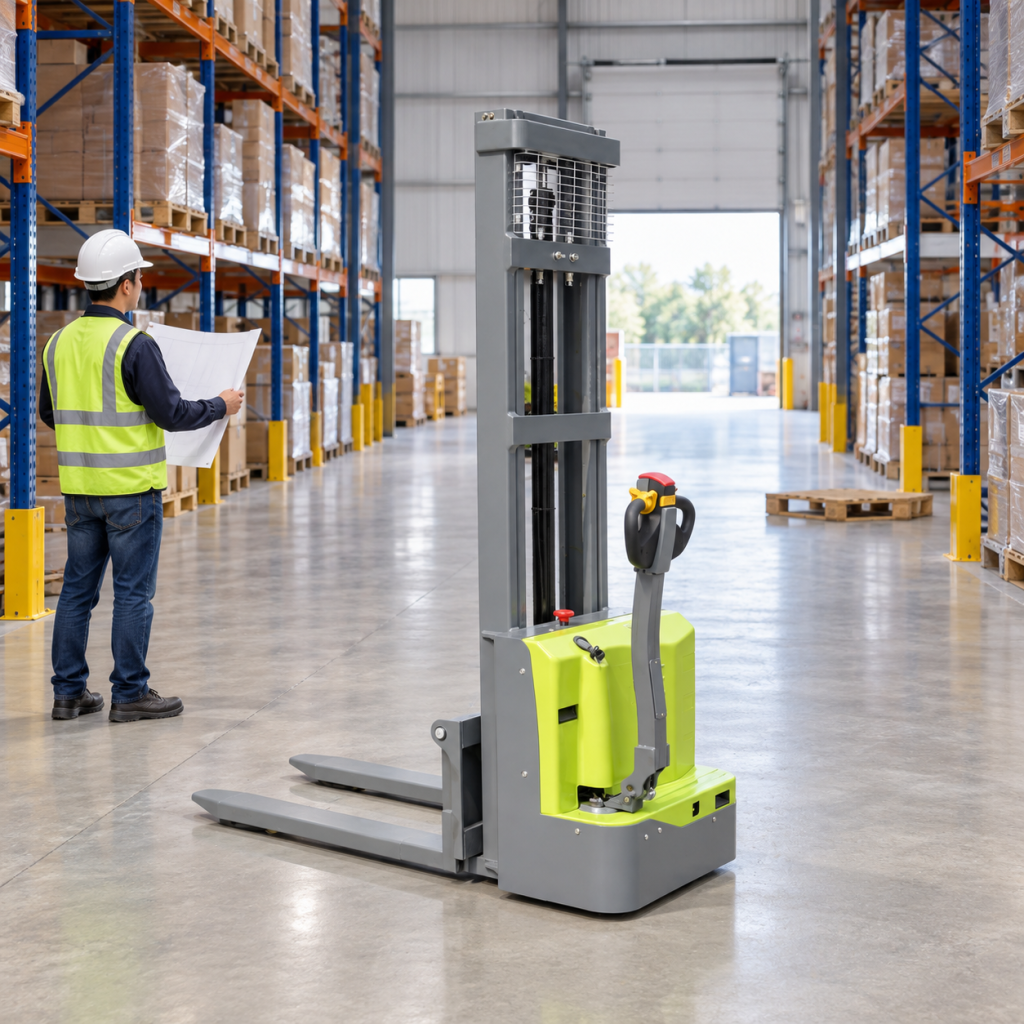
A stacker can be narrower than a warehouse aisle yet still fail to turn a loaded pallet into the rack. A useful survey measures the whole maneuver.
Measure the clear aisle, loaded pallet, truck turning path and operator walking position at every rack approach. Separate straight travel from a right-angle stack and an intersecting-aisle turn. Ask the supplier for aisle data for the exact proposed configuration, then confirm fit with a controlled site trial.

Illustrative scene generated from a Jinge product photograph; it is not a measurement of a customer warehouse or an approved clearance.
Which aisle width should a buyer record first?
A rack plan can show a wide aisle while column guards narrow the usable route. Measure the obstruction, not the drawing.
Record the narrowest clear width at the height and location the truck, load and operator will occupy. Measure between real obstructions, not only between rack design lines. Log the location, direction of travel and whether pallets, guards or temporary stock reduce the width during a normal shift.
A drawing may label an aisle as one width while upright protectors, column bases or stored goods leave less usable space. Walk each intended route and measure between the nearest fixed obstacles. Repeat where rack ends project into the aisle and where a door, sprinkler cabinet, charger or fire equipment changes the corridor. Record a floor-level width and any higher obstruction likely to meet the load or mast. A single measurement at the empty aisle entrance cannot describe its full length.
Separate clear width from the proposed operating width. Clear width is what the building currently provides. Required operating width depends on the truck, pallet dimensions, fork orientation, turning geometry and how the operator walks with the tiller. A manufacturer's published aisle figure may use a particular test pallet and approach pattern. If your pallet differs, the quoted figure is a starting point for discussion, not proof that your warehouse is wide enough.
The UK HSE guidance on workplace vehicles and loads explicitly notes that routes must accommodate modern material-handling equipment, including pedestrian-operated pallet handlers and stackers. It also discusses traffic management where a route cannot be widened. This is UK guidance, not a universal numeric stacker width. The OSHA narrow-aisle guidance gives US workplace context for why different truck types need different aisles; its example forklift widths should not be copied into a stacker quotation.
| Survey point | What to measure | Why one nominal aisle number is insufficient |
|---|---|---|
| Straight aisle | Narrowest clear width and any local pinch point | Uprights or stored stock may reduce usable space |
| Rack face | Space opposite the target pallet and any column guard | A right-angle turn needs more than straight travel |
| Aisle end | Clear width at the exit and next route | The load may swing during the transition |
| Door or cross-route | Opening, approach angle and traffic controls | A clear opening may still have an unusable approach |
Mark each point on a simple plan. Include the date and whether the width is permanent or affected by temporary storage. The buyer can then ask a supplier about a specific restriction rather than a vague “narrow warehouse.”
How does the loaded pallet change the turning path?
The unloaded chassis may turn easily, then a loaded pallet clips the rack guard. Include the load envelope.
Measure the representative pallet and its load in the orientation used at each rack. The load's width, length and overhang change the swept path even when the truck chassis stays the same. Compare the complete loaded envelope with the candidate truck's right-angle stacking information, not just its turning radius.
A stacker does not travel as an empty chassis when it puts goods away. The forks may carry a pallet whose corners extend beyond the fork tips or sides. When the truck turns, those corners describe a different path from the drive unit. The operator needs to know which side of the load approaches the rack first and whether an adjacent pallet, beam or guard limits that swing. Measure the widest regular load, the longest regular load and a heavier case if it uses a different pallet. These may be three distinct cases.
Record pallet entry orientation as well. A rectangular pallet can be approached from its short side or long side, which changes the length projecting from the stacker. If warehouse staff rotate pallets to fit a rack, say so in the survey; do not assume every product can be rotated without changing its stability or label access. Check physical fork and support-leg compatibility separately: a pallet that fits the aisle may still obstruct the machine at pickup.

Illustrative measurement scene; the image does not establish a model's turning path or pallet limit.
Manufacturer examples show why test conditions matter. A Crown M Series aisle planning guide presents different right-angle and intersecting-aisle values by pallet length and width for its own equipment. The table is useful as a method example, never as a GODWIN or Jinge specification. Ask for the proposed machine's corresponding drawing and the pallet orientation assumed in it.
If the supplier provides only a turning-radius figure, ask what point on the truck was measured and whether it includes the load. A radius can help compare chassis geometry but cannot alone prove that a rectangular pallet will clear the rack during placement. The real question is whether the complete load and truck can move from the travel line into the storage position while preserving the site’s required clearance and operator space.
Where does the walking operator need space?
A truck may fit between uprights while its operator is forced into a pinch point. Walking space counts.
Include the operator's normal position and tiller movement in the route plan. A walk-behind truck may need room beside or behind its power unit while approaching a rack, reversing and turning. Do not plan a maneuver that forces a person between the moving truck and a wall or rack.
For each regular task, sketch where the operator stands before starting, during the turn and after placement. A tiller can sweep through space not occupied by the chassis. Operators may change sides to see the load or reach the controls, but a site should not rely on someone squeezing into a trapped position to compensate for a narrow aisle. Keep the diagram realistic: include the rack face, pallet overhang and any fixed guard, not just two parallel lines on a drawing.
Observe the normal traffic pattern when the warehouse is operating. An aisle that appears roomy when empty may require the operator to share space with picking carts, pedestrians or a second truck. If simultaneous traffic is expected, the site team must decide whether to segregate movements, use a one-way pattern or reserve the aisle during stacking. The equipment purchase cannot by itself solve a circulation problem. The HSE traffic-routes guidance supports designing routes for the people and vehicles that actually use them.

Illustrative scene based on a Jinge product photograph; operator posture and clearances must be checked on the actual site.
At the target rack, identify any moment when the operator might stand in line with a raised load. The trial plan should keep observers out of the travel path and let a trained, authorised operator follow the selected truck's manual and site rules. This article does not prescribe a fixed walking side for every model. Control layouts and approved operating positions vary; the manufacturer's instructions govern the exact truck.
How are a right-angle stack and a cross-aisle turn different?
A successful turn into the next aisle does not show the same pallet can be placed at a rack. Test each maneuver.
Treat pallet placement and route circulation as separate maneuvers. A right-angle stack turns a loaded pallet into a rack position; a cross-aisle turn carries it into another travel corridor. Measure each approach, exit and obstacle, and request manufacturer data for the exact maneuver and pallet used.
At a rack face, the stacker may travel along the aisle, turn toward the rack, align the pallet, lift, set it down and withdraw. A successful unloaded turn at the aisle end does not prove that sequence. At a cross-aisle, by contrast, the load may need to swing past a rack-end guard before the drive unit follows. The outside corner of the pallet and the operator's path may be the limiting points. A building plan that lists only a continuous corridor width hides both cases.
Draw a simple top-down path for the most constrained location. Identify start position, turn direction, rack opening, final pallet position and retreat path. If the aisle is one-way, mark the direction; reversing the task can put the longer side of a load toward a different obstruction. A changing order-picking layout can move pallets into what used to be turning space, so include a floor-marking or housekeeping control if the trial depends on that area staying clear.
| Maneuver | Different question to answer | Evidence to request |
|---|---|---|
| Straight travel | Can truck, pallet and operator pass the narrowest section? | Clear-width survey and loaded envelope |
| Right-angle stack | Can the load align, lift, place and withdraw at the rack? | Model-specific aisle planning data and rack sketch |
| Intersecting turn | Can the complete load swing into the next corridor? | Cross-aisle layout with rack-end guards |
| Reverse or retreat | Can the operator leave the position without trapping or striking anything? | Full-cycle trial observation |
Do not select the smallest number from a brochure just because it looks compatible with your narrowest aisle. Confirm the table heading, pallet assumption and configuration. The Crown example cited above separates aisle cases precisely because they are not interchangeable. For a different brand or model, obtain the corresponding source rather than transferring its measurements.
One practical test is to trace the outside pallet corner on the route sketch for both maneuvers. At the rack, that corner may move toward a guard while the forks are aligning. At a cross-aisle, it may move toward temporary stock. Recording each pinch point makes the trial repeatable and helps operations keep the required space clear.
Which site conditions reduce usable aisle space?
An aisle can be clear for a trial but blocked during the normal shift. Record recurring obstructions and traffic.
Record fixed and recurring obstructions, floor condition, visibility and pedestrian activity at the same points as the width measurements. A route is suitable only if the candidate truck can complete the loaded task under its real operating conditions. A clear dry aisle at dawn may not describe a busy shift.
Rack-leg guards, floor plates, drains, columns and low doors can change how a stacker approaches a pallet. A damaged joint can interrupt a small wheel exactly where a turn begins. The site survey should identify these conditions and ask the facility team whether they will be repaired or controlled. Do not try to make the truck “fit” by allowing an unsafe floor or by storing stock in an emergency route. If a narrow aisle is also wet or sloped, the supplier needs those facts before recommending a configuration.
Visibility matters as much as the tape measure. A high or opaque load may block the operator's view around a corner. Record where pedestrians emerge, where racks or walls hide the next aisle and what traffic controls already exist. The OSHA workplace overview identifies physical conditions, pedestrian traffic, narrow aisles and ramps as distinct hazards to examine. Its forklift-focused examples are not a complete operating procedure for every stacker, but they are a useful checklist for what a site survey should not overlook.

Illustrative survey scene; site hazards and dimensions shown are not records of a real customer's facility.
Set an operating rule for temporary stock. If pallets are regularly staged in the only turning bay, a one-time demonstration conducted with the bay empty will overstate practical fit. Photograph the bay during a normal busy period and ask operations whether that staging practice can change. Similarly, identify whether the stacker must pass through a door while carrying a load or only while empty; those are different envelopes. Treat these as decisions for the site team, not product features that a sales page can guarantee away.
What should a controlled aisle trial and supplier response show?
A brochure width can look adequate while the real loaded cycle needs repeated repositioning. Put the trial conditions in writing.
Before a loaded trial, confirm truck identity, approved load, pallet orientation, route and rack task. Use a trained operator and keep observers outside the path. Record the full approach, placement, withdrawal and cross-aisle turn at limiting points. Ask the supplier to document what was tested and any unverified conditions.
The supplier should receive a compact evidence pack before choosing a demonstration unit: aisle plan with measured clear widths, rack-opening dimensions, pallet and load data, photographs of each pinch point and traffic rules. Ask for a dimensioned drawing of the proposed truck and its relevant aisle-planning information. The actual demonstration unit should match that proposed configuration. If a different mast, fork or chassis arrives, record the difference; an easy trial with a substitute may not validate the quotation.
At the site, begin with a stationary review of the route and documented capacity. If there is an unsafe obstruction, damaged floor or missing capacity information, resolve it before attempting a loaded movement. During an approved trial, the authorised operator should follow the manufacturer's travel and lifting instructions. Observe the full movement from a safe position. Note contacts, repeated repositioning, visibility problems and where a person stands. A pass is meaningful only for the recorded load, route and operating conditions.

Illustrative preparation scene; no actual loaded trial or GODWIN clearance approval is represented.
| Trial record | Minimum detail | Why retain it |
|---|---|---|
| Truck and load | Exact configuration, pallet orientation and verified weight | Prevents applying one result to a different build |
| Route point | Aisle/rack ID, measured width and direction | Locates the limiting maneuver |
| Observation | Clearance, contacts, operator position and visibility | Shows whether fit is practical, not just theoretical |
| Follow-up | Repair, traffic control, revised model or retest | Turns a failed attempt into an actionable decision |
The GODWIN electric stacker category contains different equipment designs. Send the site evidence through the GODWIN contact page and request model-specific aisle information. Do not infer an approved width from a photo, the category page or another manufacturer's example. Keep the final survey with the accepted quote so a later pallet or layout change triggers a fresh check.
Write down the conditions under which the result applies: the exact pallet sample, any temporary exclusion of pedestrians, the clearance used at the rack and whether staged stock was removed for the test. If daily operations cannot preserve those conditions, the trial result needs a different traffic plan or a different machine, not a silent assumption that the aisle will stay empty.
Conclusion
The useful aisle measurement is the space available for the complete loaded maneuver and walking operator, not a single gap between racks. Map the limiting points, request data for the exact stacker and pallet, then verify the normal full-cycle task in a controlled trial. Preserve the evidence for future changes to loads, racks and traffic.


 English
  Español
  Français
  العربية