 Skip to content
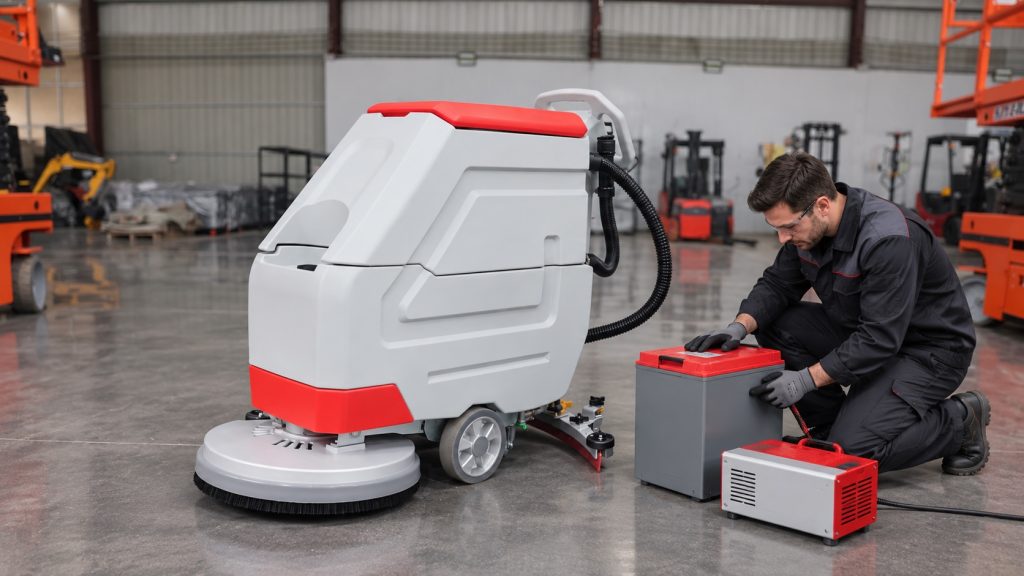
I want longer useful battery service, but a generic charging tip can be wrong for the pack fitted to my machine.
Care for a floor scrubber battery by identifying the exact delivered chemistry, pack, charger, and manuals first. Follow their approved charging, inspection, storage, and service instructions; keep connectors and the charging area safe; and record abnormal behavior early. Do not apply flooded-battery maintenance to sealed or lithium packs.
The battery selection guide helps plan a purchase. This article focuses on care of the battery actually delivered.
Which Battery and Charger Are Installed?
I cannot make a care schedule from the model name if the order allowed more than one battery package.
Read the delivered battery and charger labels, machine nameplate, order documents, and matching manuals. Record chemistry, manufacturer, model, voltage and capacity as stated, charger identity, and any approved pairing or storage instructions. If the records conflict, stop and ask the supplier before charging or servicing.

Do not infer battery chemistry from a marketing phrase such as “maintenance-free” or from the scrubber model alone. The current GODWIN product knowledge does not establish a universal chemistry or charger for every delivered configuration. A common operation manual may contain a representative lead-acid description that does not prove the battery inside a specific order. The delivered pack and charger documentation decide what the operator should do.
Record the full identification at handover. Include photos of accessible labels, the machine model and serial, the charger label, and any approved pairing statement. Keep these with the purchase and service file. If labels are missing or unreadable, obtain confirmation from GODWIN or the responsible supplier. Guessing the charger from connector shape is unsafe: physical fit does not establish the correct charging profile.
Ask who may perform which tasks. Routine visual checks and charging may be assigned to trained operators. Electrolyte handling, electrical diagnosis, pack replacement, and damaged-battery response may require specifically trained personnel and local safety controls. The battery maker's instructions and site procedures determine the boundary.
Trojan Battery's manuals collection separates flooded, AGM, and lithium product guidance. That distinction illustrates why a single “scrubber battery maintenance” checklist should branch by the delivered product rather than force one procedure onto all packs.
| Identification item | Where to confirm | Why it matters |
|---|---|---|
| Pack chemistry and model | Battery label and manual | Selects care and safety rules |
| Charger model | Charger label and approved pairing | Prevents profile mismatch |
| Machine identity | Nameplate and order | Links battery to delivered unit |
| Service authority | Battery and machine manuals | Defines operator vs technician tasks |
| Replacement path | Supplier approval | Avoids unsupported substitution |
Keep this record current after any authorized replacement. A battery-care log tied to an old pack is misleading.
What Charging Routine Should Operators Follow?
I can damage a schedule by charging at the wrong time, but I should not invent one universal rule for every chemistry.
Charge with the approved charger and procedure for the exact battery and machine. Follow the maker's instructions for connection, ventilation, temperature, charge completion, and permitted partial charging. Set a realistic work and charging window; stop using a pack that shows unusual heat, odor, damage, or repeated charger faults.

The first rule is compatibility. A charger with the same plug or nominal voltage may still use the wrong profile or control communication. Keep the approved machine, pack, and charger together as documented. Do not bridge contacts, change a plug, or select a hidden charger program because a generic article recommends it. Qualified personnel and the manufacturer should approve any change.
The second rule is environment. The charging area should be planned with the local facility team for power, access, ventilation, fire response, traffic separation, and storage. Exact requirements vary by battery and charger. Our charging-area planning article lists the information to collect, but installation and compliance decisions belong to competent local review and the delivered instructions.
The third rule is schedule. Record the longest work block, normal return time, and true interval before the next shift. Flooded lead-acid, sealed lead-acid, and lithium systems may have different rules for charging and interruption; even within one chemistry, products differ. Use the delivered manufacturer's guidance rather than a universal “always fully discharge” or “charge whenever convenient” slogan.
Train the operator to watch the charger's normal indication and to report a failed or abnormal cycle. Repeated undercharge, unexplained short runtime, or a charger that never reaches its normal completed state should enter a service case. Do not compensate by extending an unapproved charge cycle or using an unidentified replacement charger.
Which Care Tasks Depend on Chemistry?
I know that some flooded batteries need electrolyte attention, but I must not apply that instruction to a sealed pack.
Flooded lead-acid, sealed lead-acid, and lithium packs have different maintenance boundaries. Only perform tasks expressly assigned by the exact battery manual and site procedure. Never open a sealed battery, add water to AGM or lithium equipment, or assume a flooded-battery watering schedule applies to another pack.

For a flooded lead-acid battery, the manufacturer may specify inspection and water maintenance by trained personnel using protective equipment and a defined sequence. The exact timing, water type, level, and ventilation requirements come from that battery's manual. Do not reduce them to a one-line blog tip. The Trojan flooded-battery guide is an example of manufacturer-specific guidance, not proof that a GODWIN order contains that Trojan product.
AGM and gel products are sealed designs with different care and charging needs. The fact that they do not have routine watering does not make them maintenance-free in the broader sense: external inspection, approved charging, clean connections, temperature limits, and fault reporting can still apply. Follow their own manuals and service boundary.
Lithium systems can include battery management electronics and specific charger communication or protection behavior. Operators should not reset protective faults, open the pack, or substitute a charger on guesswork. Follow the exact product's charging, temperature, storage, and transport documentation. If the pack reports an abnormal state, stop and involve the supplier or qualified service.
| Battery type | Operator assumption to avoid | Control document |
|---|---|---|
| Flooded lead-acid | “Any worker can top up at any time” | Exact battery manual and site training |
| AGM or gel | “Sealed means no inspection needed” | Exact pack and charger manuals |
| Lithium | “Any matching plug can charge it” | Approved pack–charger pairing |
| Unknown | “The scrubber model tells us chemistry” | Delivered labels and order record |
Do not quote a fixed cycle life or warranty period without the exact product and conditions. Battery service depends on configuration, use, care, and environment.
The shift log should name the installed pack, charger, charge start and completion indication, and any unusual temperature or fault message. This makes the correct manual easy to find and prevents instructions from one chemistry being applied to another. When a machine is transferred between sites, hand over those records with the equipment. A new operator should verify the delivered labels before following an inherited charging routine.
What Should Be Checked Before and After a Shift?
I need a short routine that catches visible problems without inviting untrained operators into electrical service.
Use the delivered machine and battery manuals for pre-use and after-use checks. Look from an accessible safe position for damage, leaks, loose external parts, abnormal indications, and charger problems. Record battery state and any change in runtime. Stop and escalate conditions outside routine operator authority.
Before use, confirm that the pack and charger record belongs to this machine and that the charge indication is normal for the planned job. Check the exterior for visible damage or leakage without opening covers beyond those allowed by the machine instructions. Ensure connectors accessible to the operator appear correctly seated and undamaged. If there is an unusual smell, heat, swelling, corrosion, or warning, do not start another shift simply to “see if it clears.”
During work, note significant changes: the machine slows or stops earlier than it usually does on the same route, a warning appears, or charging behavior changes. Those are symptoms, not a diagnosis. Floor resistance, brush setup, water load, temperature, and route differences can affect energy use. A log helps service distinguish those factors from a battery or charger problem.
After work, park and charge according to the approved sequence. Keep the charging area clear and protect cables from vehicle traffic or crushing. Do not leave loose wires, improvised adapters, or liquid around the charger. Follow the manual's end-of-shift machine care so solution or recovery water is not left to contaminate the storage area.
The floor scrubber maintenance checklist covers broader routine care. Battery-specific work should remain attached to the exact pack documentation, especially after any replacement.
How Should Storage and Infrequent Use Be Handled?
I may park a scrubber for weeks between projects, and the normal daily charging routine may no longer fit.
Use the exact battery manufacturer's storage state, temperature, inspection, and recharge instructions for planned inactivity. Record the start date, pack identity, storage location, checks, and return-to-service steps. Do not assume a universal state of charge, calendar interval, or charger connection practice across chemistries.
The machine may be inactive for holidays, a seasonal site closure, a replacement project, or international shipment. Each creates a different duration and environment. Ask the battery supplier for the storage procedure for that exact pack. The right state and maintenance interval can differ materially between flooded, sealed, and lithium products and between manufacturers.
Choose a location reviewed for the battery, charger, and machine under local rules. Protect the unit from unauthorized use, impact, water exposure, unsuitable temperature, and blocked access. If the charging location is shared with other equipment, label the approved charger and machine pairing. A stored charger can be swapped accidentally unless the record is clear.
Before returning a machine to service, follow its inspection and charging procedure. Confirm that the manual and service record still match the fitted pack, especially if another team has worked on the unit. A battery that has been stored outside the approved conditions needs qualified review; repeated attempts to charge an abnormal pack are not a recovery method.
For shipping or disposal, battery type and jurisdiction matter. Obtain the relevant manufacturer documents and competent logistics or environmental advice rather than using a routine warehouse storage checklist as a transport authorization.
Keep the storage and return-to-service record with the machine so the next operator knows which instructions were followed.
When Should Service or Replacement Be Considered?
I do not want to replace a battery just because one shift ended early, but I also do not want to ignore a recurring fault.
Escalate repeated short runtime, abnormal charging, physical damage, leaks, protective warnings, or inconsistent pack behavior with a documented symptom history. Qualified service should check the complete machine–battery–charger system and operating conditions. Replace only with an approved configuration, then update the care and charging records.
Prepare a useful service record. Include machine and battery identification, charger model, dates of affected shifts, approximate route and load, charge indications, warning codes or photos, environmental conditions, and any approved checks. A single short shift can arise from more cleaning passes, a different brush, difficult soil, incomplete charging, or battery degradation. A technician needs context to separate them.
Do not open the pack, substitute cells, bypass protection, or use a different charger to test a theory. Those actions need product-specific qualified procedures and may create safety or warranty issues. If there is physical damage, heat, smoke, or leakage, follow the site emergency and battery maker's instructions immediately. Keep people away from the affected unit.
| Service symptom | Evidence to retain | Why it helps |
|---|---|---|
| Short runtime | Comparable route, load and charge history | Separates workload from pack issue |
| Charger fault | Charger model and indication photo | Identifies pairing and error |
| Physical damage | Safe exterior photos and event time | Supports safety triage |
| Intermittent stop | Machine warnings and operating conditions | Helps diagnose the system |
| Replacement need | Approved pack and charger mapping | Prevents unsupported swap |
Ask GODWIN or the responsible supplier to confirm part compatibility, warranty boundary, and the approved replacement process. A new battery should be documented as a new configuration rather than silently inheriting the old pack's care schedule.
Before approving replacement, compare the observed runtime against a similar route and workload and check whether the charge cycle completed normally. Record changes in operators, floor resistance, water use, and cleaning method. A shorter shift can reflect more work rather than battery failure. If a qualified technician confirms replacement is needed, document the pack and charger pairing, installation date, service route, and updated operator instructions for the new configuration.
Conclusion
Identify the delivered pack and charger, follow their own manuals, document changes, and leave electrical faults to qualified service.


 English
  Español
  Français
  العربية